
The EMC Club
A forum and network where members can share the latest EMC knowledge
Electronic product compliance
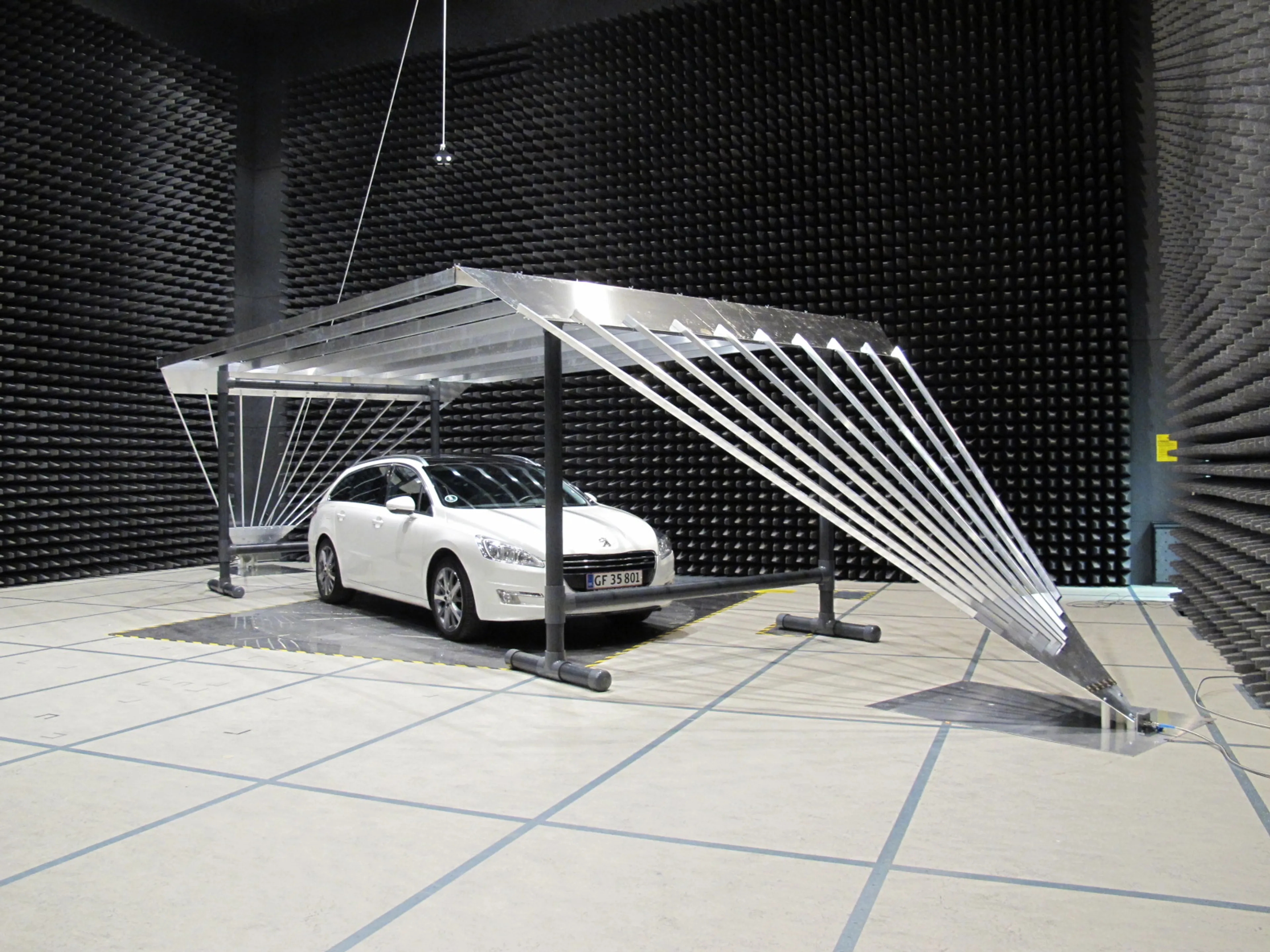
Gain access to advanced EMC testing facilities with semi-anechoic chambers and full-anechoic rooms, supported by substantial expertise in accredited EMC testing. The facilities are used by manufacturers of electronic products and systems that require controlled evaluation of electromagnetic emission and immunity characteristics to assess operation without electromagnetic interference. Testing is carried out across a wide range of products, from small electronic devices to large machinery, where stable functionality under defined electromagnetic conditions must be evaluated.
The need arises during product development, design modification or technical investigation, where emission levels and immunity behaviour must be measured under controlled and repeatable conditions. Without documented test results, it becomes difficult to assess how products respond to electromagnetic environments. Testing is performed in accordance with relevant international product-specific and generic standards, and results are delivered as documented measurements and test reports that form the basis for technical evaluation.
Target group and benefits
The EMC testing facilities are used by manufacturers of electronic equipment, industrial systems, and electronic devices that require evaluation of emission and immunity characteristics. Typical users include development engineers and test engineers responsible for assessing electromagnetic performance during development and verification activities. Testing is applied when introducing new designs, modifying existing products or analysing electromagnetic interference identified during internal testing.
Test results document emission levels, immunity performance and product response under defined electromagnetic conditions. These results are used in technical documentation and as a basis for evaluating product performance, identifying deviations and supporting further design or test activities. Controlled test environments enable repeatable measurements, providing consistent documentation across different product types and test scenarios.
Relevant test programmes may also include testing in reverberation chamber.
Arrange emission and immunity testing in our semi-anechoic and full-anechoic chambers according to relevant EMC standards. Contact us to define test setup, product dimensions and scheduling.
Use cases
Emission testing of electronic products
Measure radiated and conducted emissions across defined frequency ranges to document electromagnetic noise generated by electronic equipment under controlled conditions.
Immunity testing under defined conditions
Expose products to defined electromagnetic disturbances, including radiated fields, conducted signals and transient events, to evaluate functional performance during exposure.
Investigation of interference issues
Identify sources of unwanted emissions or susceptibility by reproducing electromagnetic conditions in controlled environments to support technical analysis.
Testing of large and complex equipment
Evaluate EMC performance of large installations using chambers with high load capacity and adaptable configurations for different product sizes.
Facility specifications
Chamber types
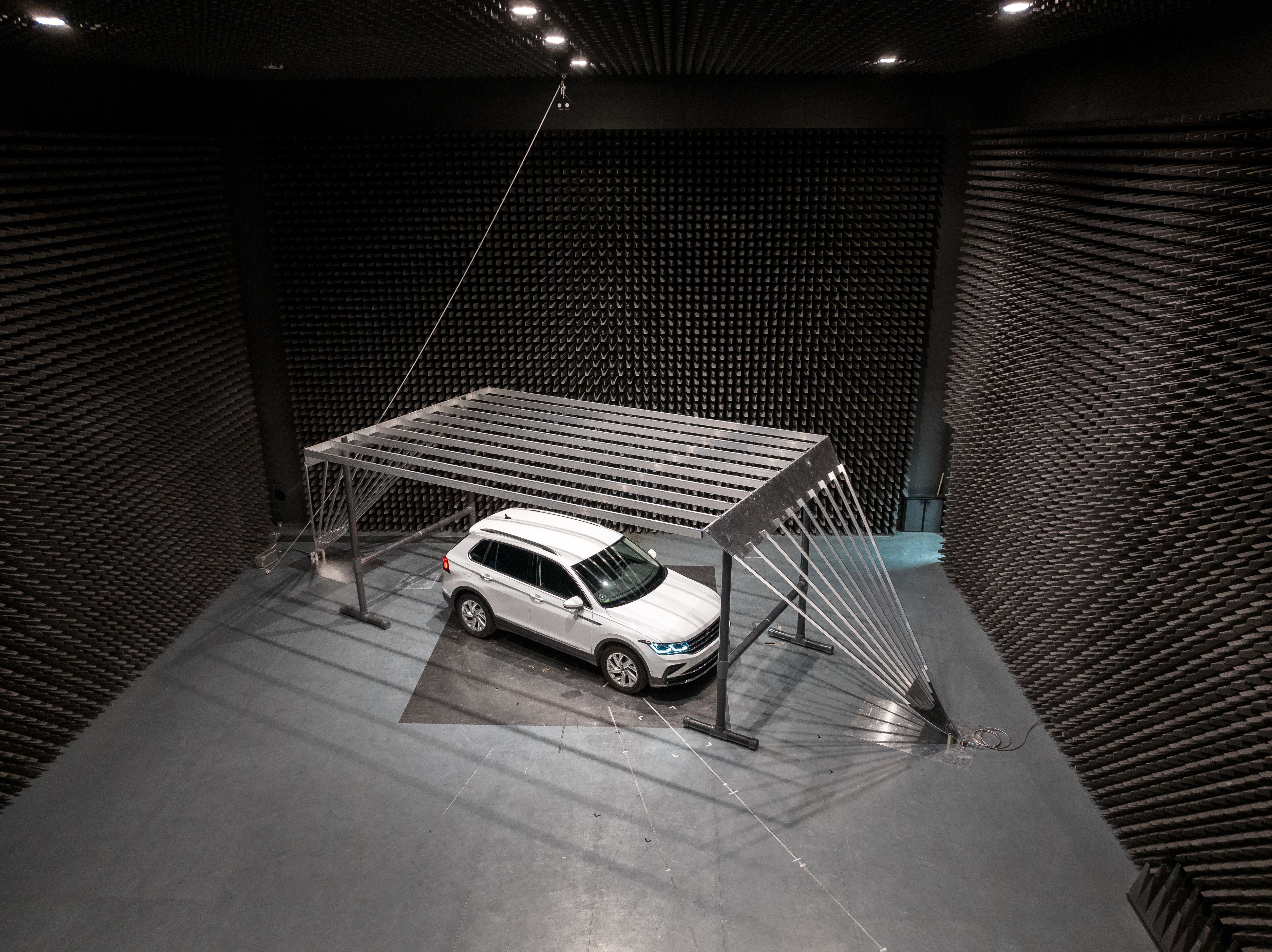
Includes semi-anechoic chambers with absorber-lined walls and ceilings and reflective floors, as well as full-anechoic chambers fully covered with absorbers, enabling controlled electromagnetic environments for testing.
Frequency range
Supports radiated and conducted emission testing from 9 kHz to 40 GHz and radiated immunity testing from 26 MHz to 40 GHz, covering a broad range of electromagnetic conditions.
Chamber dimensions and access
Main chamber dimensions of 20.1 × 13.0 × 8.8 m with a 3 × 3 m port and door dimensions of 1.2 × 2.1 m support testing of both small devices and large equipment.
Measuring distances
Emission measurements can be conducted at 1 m, 3 m and 10 m distances in accordance with applicable standards.
Load capacity and turntable
Floor load capacity up to 10,000 kg/m² and a rotating platform with 5 m diameter supporting up to 10,000 kg distributed load enable testing of heavy equipment.
Immunity test capabilities
Supports ESD testing up to ±30 kV, fast transient/burst up to ±4.8 kV, surge testing up to ±10 kV, conducted immunity from 9 kHz to 230 MHz and magnetic field testing at 50/60 Hz up to 1000 A/m.
Power and connections
Provides multiple power supply options and signal connections including Ethernet, USB, HDMI, CAN and RS232, supporting diverse test configurations.
Facility setup
Selection of chamber environment
Choose between semi-anechoic and full-anechoic chambers depending on whether emission or immunity performance is evaluated.
Measurement distance configuration
Set measurement distances at 1 m, 3 m or 10 m to align with relevant standards and product categories.
Adjustment of disturbance levels
Define field strengths, voltage levels and disturbance parameters in accordance with the selected test standard.
Flexible installation of test objects
Accommodates both small devices and large equipment through adaptable layouts, high load capacity and rotating platforms.
Integration of power and signal interfaces
Configure power supply and signal connections to reflect operating conditions during testing.
Standards
CISPR standards
Testing includes CISPR 11, CISPR 22, CISPR 25 and CISPR 32 for evaluation of electromagnetic emissions across relevant frequency ranges.
EN/IEC 61000-4 series
Immunity testing is performed in accordance with EN/IEC 61000-4-2, 61000-4-3, 61000-4-4, 61000-4-5, 61000-4-6, 61000-4-8, 61000-4-9 and 61000-4-10.
Product standards
Testing can be conducted according to product-specific standards such as EN 60945 and EN/IEC 60601-1-2 where applicable.
Locations
Brøndby
Park Allé 345
2605 Brøndby
Phone: +45 43 25 14 50
E-mail: info@forcetechnology.com
