
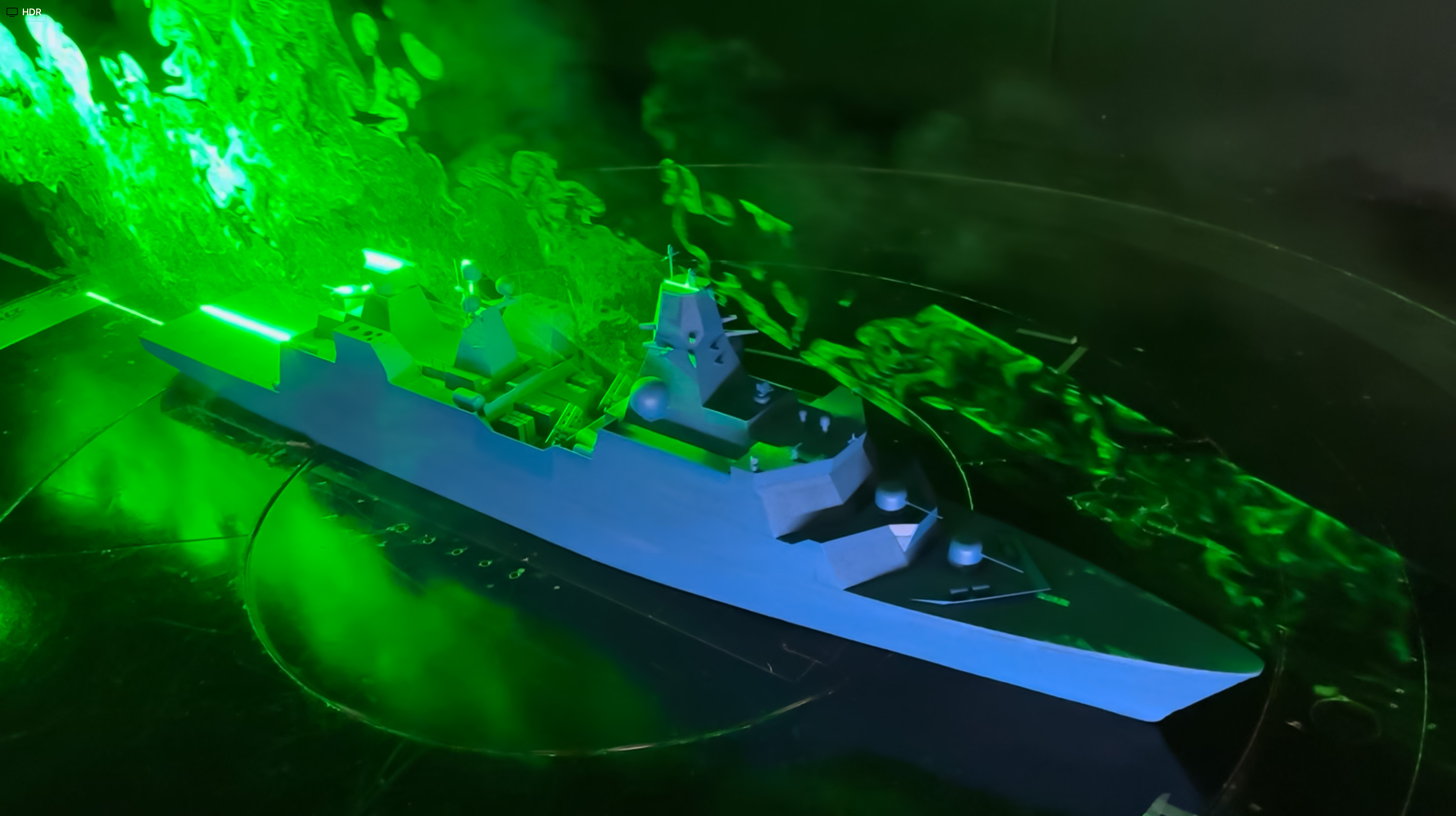
The service includes a defined wind tunnel test programme agreed with the client, as well as a vessel model, typically 1.0 to 2.0 m in length. The programme defines which conditions are assessed in relation to operational and class requirements for propulsion, manoeuvring, dynamic positioning, mooring and stability. The tests are carried out in one of five wind tunnels, and the client is normally recommended to attend during testing.
Aerodynamics and wind engineering
Aerodynamic assessment of vessels in a wind tunnel
Assess vessel aerodynamics early to support design teams, owners and operators with input for design and class requirements.
Vessel designers, owners and operators may need wind tunnel assessment when aerodynamic conditions affect propulsion, manoeuvring, dynamic positioning, mooring or stability. The need typically arises in design, when a vessel must be assessed against operational and class requirements.
Operational conditions and local flow effects
Unclear aerodynamic behaviour can lead to smoke nuisance, difficult helicopter operations, uncertain wind and current loads, unreliable wind measurements or poor wind comfort. The service provides documented aerodynamic data and assessments that support the evaluation of these conditions and further design work. It's part of a suite of aerodynamic test services.
Challenges
When aerodynamic effects are not clarified early in vessel design, operation can be affected by smoke, wind and difficult local flow conditions.
Smoke dispersion affects decks and air intakes
Unfavourable wind conditions can reduce funnel performance and spread smoke across passenger decks, outdoor work areas or ventilation inlets. SO2 and NOX near ventilation inlets can, if exposure limits are exceeded, cause severe health problems and operational restrictions.
Helicopter operations become harder to assess
For vessels with helicopter decks, difficult wind and sea states can create uncertainty about serviceability. Without early assessment, design teams and owners lack reliable input for these areas.
Wind and current loads complicate design choices
Wind and current forces affect propulsion, manoeuvring, dynamic positioning, mooring and stability. If these loads are not analysed in design, dimensioning of thruster units and dynamic positioning units becomes less certain.
Local flow conditions reduce measurement accuracy
Anemometers on vessels are affected by local flow fields around the ship. Without calibration data, wind speed and direction measurements become less reliable in harbour manoeuvring, helicopter operations and dynamic positioning.
Open areas may be exposed to strong winds
Recreational and outdoor working areas can be exposed to strong winds caused by sea conditions and the vessel's forward motion. If local gust effects are not understood, comfort and available working time can be affected.
Benefits
Get documented aerodynamic results that support design decisions, operational assessment and interpretation of sea trial results.
Establish a reliable basis for helicopter operations
Assessment data provides insight into wind and flow conditions around helidecks and operation zones. This is used to evaluate usability and operational limits and to support design of these areas.
Improve the basis for wind measurements
Calibration data for anemometers enables correction of measurements for local flow effects. This provides more reliable data for harbour manoeuvring, helicopter operations and dynamic positioning.
Support assessment of wind conditions in open areas
Results provide insight into local wind conditions and gust effects on decks and working areas. This is used to evaluate comfort, usability and planning of work in these areas.
