
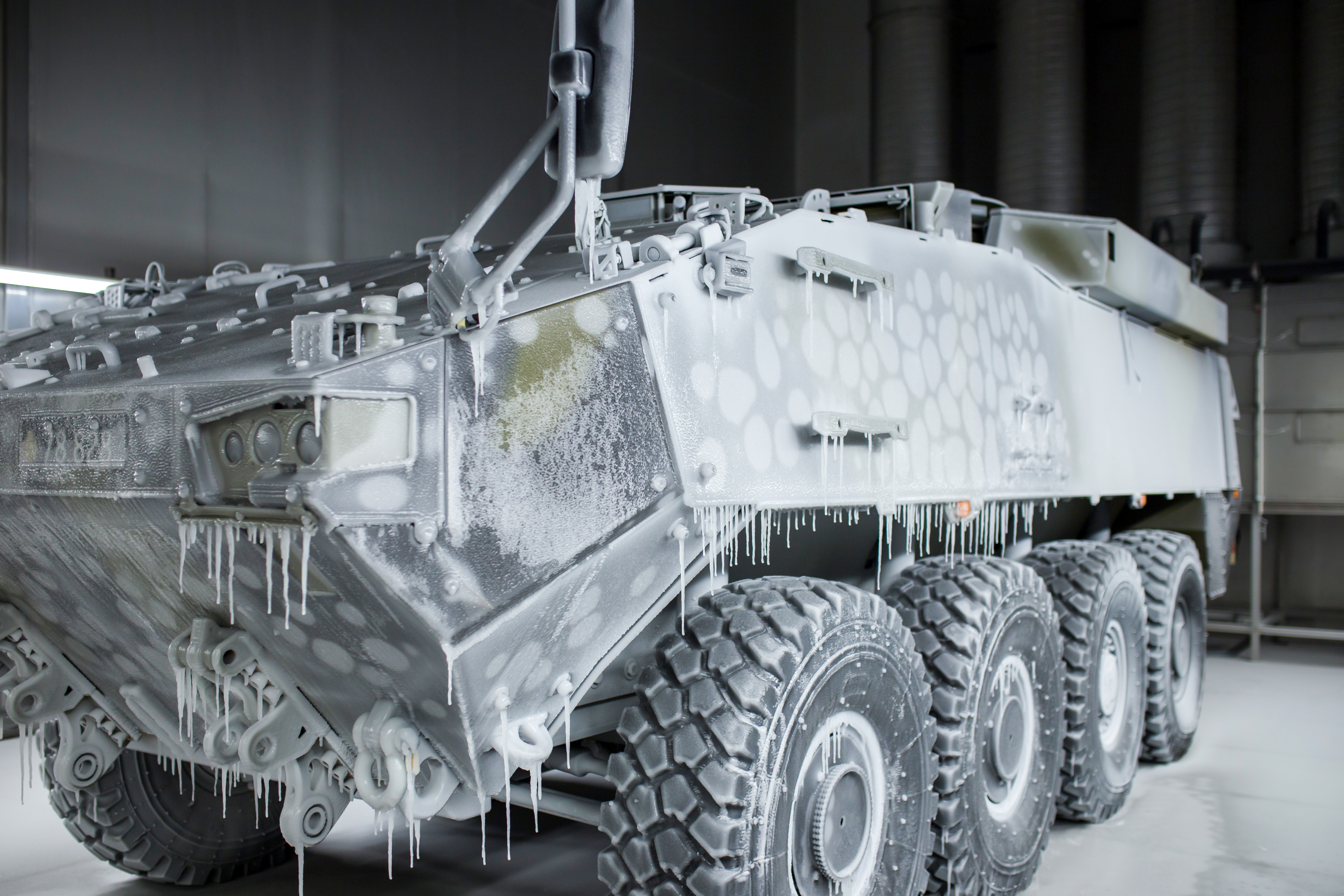
Testing can be performed in a 900 m2 large climate chamber where temperature, humidity and simulated sun exposure can be controlled independently or combined. This enables simulation of operating conditions relevant for offshore and land-based environments. Controlled exposure creates a consistent and repeatable basis for evaluating how materials, components and systems perform under climatic stress
Mechanical and environmental testing
Climatic testing of large components under controlled conditions
Test large components and systems under realistic climatic conditions to support design, validation and implementation in e.g. offshore.
Climatic testing process of large components supports engineering and technical decision-makers when systems must perform under varying environmental conditions. The need arises during development prior to implementation or during operation, where extreme temperature and humidity in environments may affect materials and system performance.
Validation before implementation
Testing under controlled and combined climatic conditions is part of our environmental testing services and provides a reliable basis for assessing performance and identifying critical stress factors. This supports aligned technical decisions and reduces uncertainty in design and implementation.
Challenges
When large components face complex climates, missing validation delays decisions and increases performance risk.
Unclear climatic impact delays decisions
Without documented exposure to relevant climatic conditions, it is difficult to assess how materials, interfaces and protective solutions behave. This delays technical evaluation and slows design progression.
Combined environmental stresses are not assessed
If environments with temperature, humidity and sun exposure are not evaluated together, systems may be judged on an incomplete understanding of actual operating conditions. This increases the risk of unexpected interactions during use.
Full-scale systems are not evaluated
Standard test setups may not accommodate large components or integrated systems used across offshore installations, buildings and transport solutions. This limits the ability to assess performance in configurations that reflect actual implementation.
System performance remains uncertain before use
Without testing complete systems under climatic stress, organisations lack documented insight into operational behaviour. This creates uncertainty in planning, installation and expected performance over time.
Benefits
Enable confident design, reduce failure risk and support validation and deployment decisions with reliable data
Enable confident design decisions
Verified test data provides a clear basis for assessing material behaviour and system performance, enabling teams to refine designs and avoid costly redesign later in the process.
Reduce risk before deployment
Early insight into climatic impact helps identify potential failure mechanisms before installation, reducing the risk of operational issues and unplanned downtime.
Strengthen documentation and approvals
Test results provide a credible and traceable basis for internal review, stakeholder alignment and compliance processes, enabling clearer communication and more efficient approval workflows.
Support lifecycle and performance planning
Insight into performance under stress conditions enables more accurate durability assessment, maintenance planning and long-term evaluation, supporting better-informed lifecycle decisions.
