
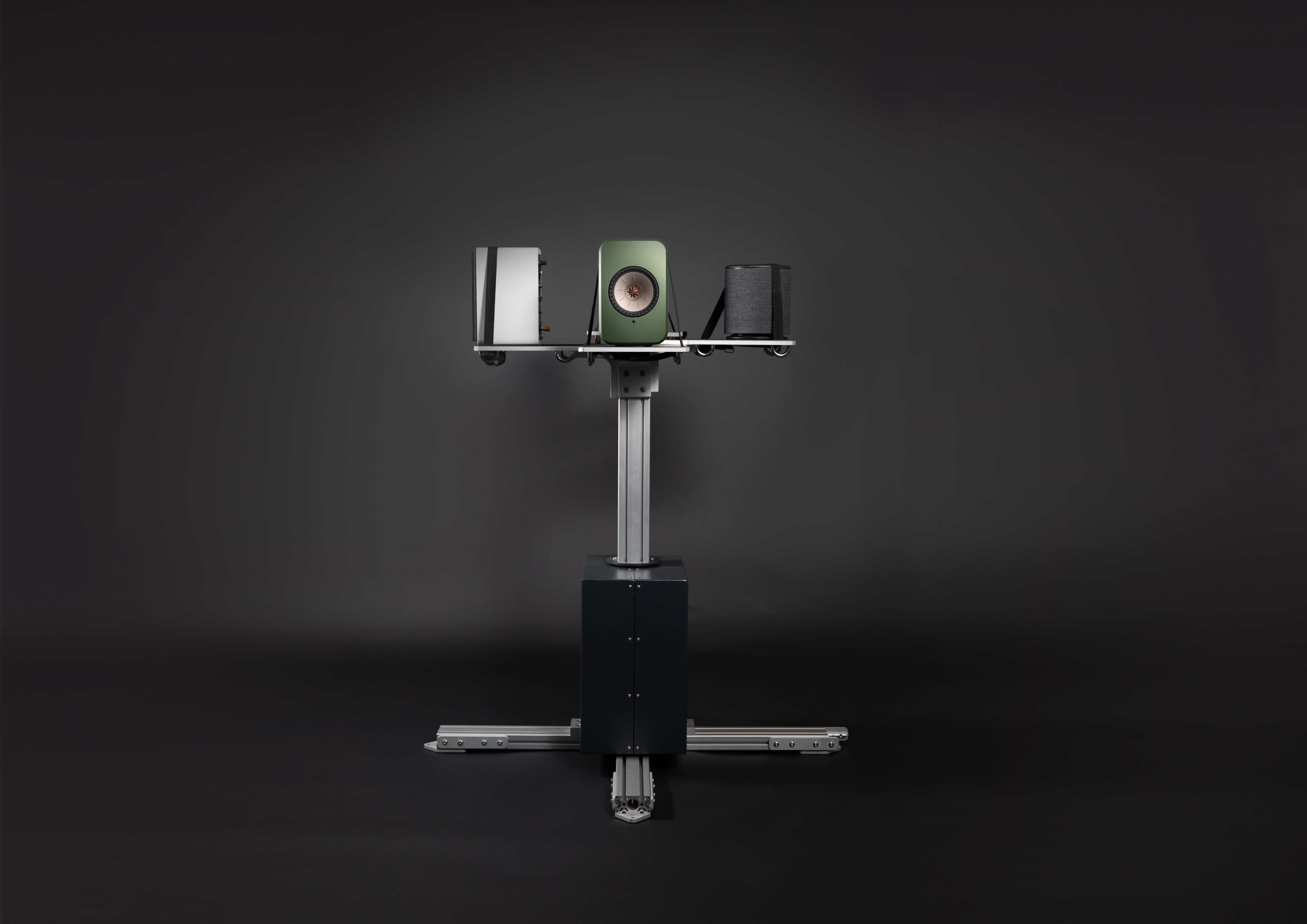
The Low Noise Rapid Speaker Spinners rotate loudspeakers during testing so evaluation can take place under the same listening position rather than through manual rearrangement. The device is used for perceptual evaluation of compact loudspeakers and for benchmark testing under controlled conditions.
Sound quality
Low Noise Rapid Speaker Spinners for loudspeaker evaluation
Use a speaker spinner to support perceptual evaluation of compact loudspeakers where room position affects sound colouration.
Low Noise Rapid Speaker Spinners support perceptual evaluation of compact loudspeakers in listening tests where room placement affects how the loudspeakers sound. The product is relevant when different loudspeaker positions in the room create sound colouration variations, making it harder to benchmark loudspeakers under the same listening conditions.
Controlled loudspeaker comparison in the same room position
The product supports sound quality tests in which loudspeakers are evaluated under more consistent conditions than manual room rearrangement allows. It is designed for rapid benchmark testing and for evaluation of loudspeaker characteristics from different angles, including frequency response and dispersion pattern.
Challenges
When loudspeakers are compared from different room positions, colouration varies and test conditions become inconsistent.
Different room positions change colouration in tests
When loudspeakers are placed in different positions in the room, the sound is coloured differently.
Manual repositioning makes tests slow to run
When loudspeakers must be rearranged during the test to keep conditions aligned, the process becomes difficult and slow.
Benefits
Reduce colouration variation in comparisons
By keeping benchmark listening tied to the same room position, the spinner reduces variation caused by changing loudspeaker placement. This supports more consistent comparison of compact loudspeakers during perceptual evaluation.
Run tests quickly with low-noise rotation
The spinners are almost silent and take two seconds to position loudspeakers. This provides a faster alternative to manual rearrangement during listening tests while maintaining the intended listening setup.
