
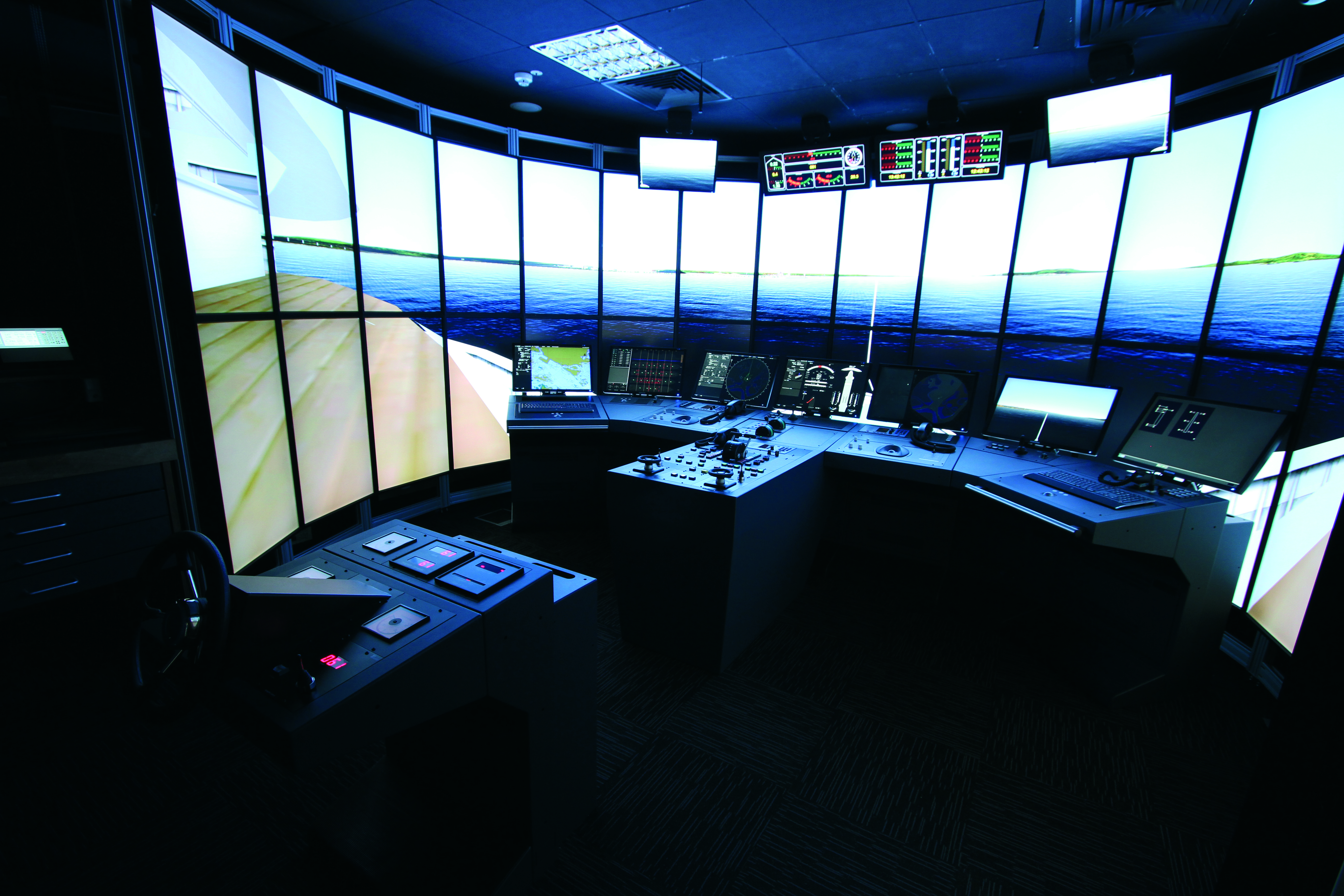
Users work with the SimFlex4 ship bridge simulator environment, developed continuously for more than 30 years, with a focus on modelling the hydrodynamic and aerodynamic characteristics that affect vessel motion. The modelling addresses the forces acting on the vessel and the related equations of motion, providing a realistic basis for maritime exercises, manoeuvre assessment and simulator studies.
Maritime simulators
Ship bridge simulators for training, practicing and planning
Use a realistic ship bridge simulator training to support maritime teams in training, practice and planning where vessel behaviour and port conditions must be assessed credibly.
Ship bridge simulator training supports mariners and maritime teams by enabling the testing of manoeuvres, decisions and planning scenarios in a virtual environment before use in real operations. As part of a broader portfolio of maritime simulators, the simulator provides a realistic environment for evaluating vessel behaviour and operational scenarios.
Realism for training and planning
SimFlex4 has been continuously developed for more than 30 years, with a focus on modelling the hydrodynamic and aerodynamic characteristics that affect vessel motion. This provides a credible basis for simulator work, enabling users to assess manoeuvres, compare alternatives and support qualified decision-making through a shared, realistic framework.
Challenges
When simulator realism is insufficient, maritime teams get a weaker basis for training, planning and operational decisions.
Unrealistic vessel behaviour weakens training value
When mariners do not recognise simulated manoeuvring behaviour as credible, it becomes more difficult to practise handling, assess vessel response and build confidence in decisions that later need to work in real operations.
Inaccurate port conditions reduce planning reliability
When bathymetry, marine structures, landmarks or layout do not closely reflect actual conditions, simulator studies become less useful for navigation work, engineering assessments and operational planning.
Lack of a shared basis slows decision-making
When the simulator environment does not credibly address the concerns and interests of the involved parties, it becomes harder to compare options, clarify uncertainties and move decisions forward.
Benefits
Gain a realistic simulation basis that supports decision-making, planning, work and operational evaluation.
Strengthen decisions with a shared basis
A realistic simulation environment provides the involved parties with a common basis for reviewing scenarios, comparing alternatives and discussing practical consequences. This supports qualified decision-making in training, practice and planning, where several interests must be considered simultaneously.
