
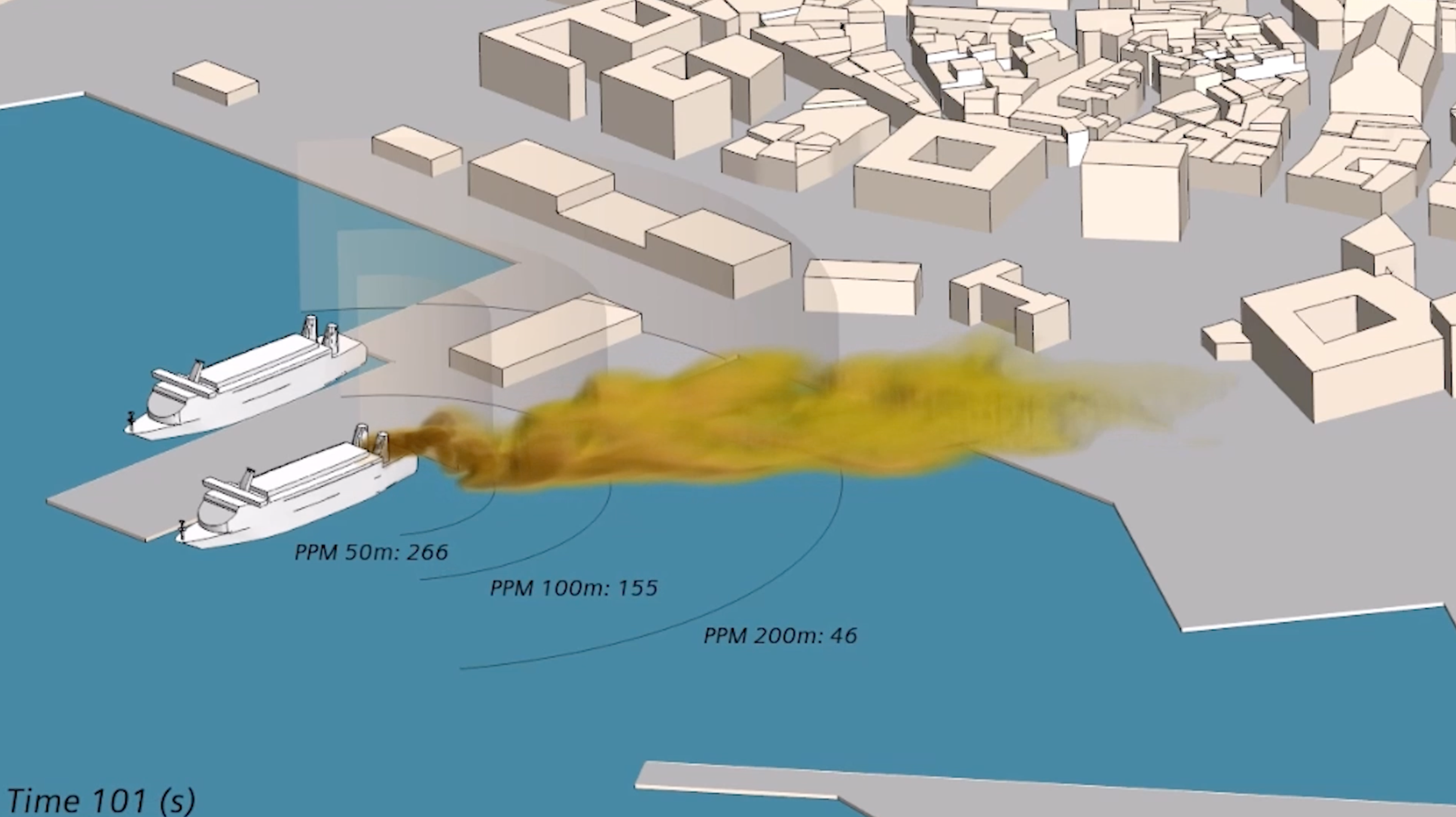
The service includes creation of 2D and 3D CFD models for leakage of hydrogen, ammonia, methanol or other green fuels. Models are configured for specific environments such as process plants, storage areas and transport systems, representing dispersion in both gas and liquid phases depending on the scenario.
Simulation and CFD for energy-, process- and production systems
Simulate green fuel leakage with CFD
Simulate green fuel leak scenarios using CFD to assess dispersion behaviour and support safety decisions
Green fuel leak simulation supports safety managers, engineers and compliance officers working in production plants, storage facilities, harbours and transport systems where hydrogen, ammonia or methanol are handled. When leaks or spills occur, dispersion behaviour can be difficult to predict, making risk assessment challenging.
Unclear dispersion behaviour delays risk assessment
Computational Fluid Dynamics (CFD) simulations enable the modelling of gas and liquid leakage and dispersion in a controlled virtual environment. By analysing how substances spread under specific conditions, the service provides a clearer basis for evaluating flammability, exposure and safety scenarios. This enables teams to progress with documented input for ATEX zoning, ventilation design and hazard assessments. The service is part of our expertise area Simulation and CFD for energy-, process- and production systems.
Challenges
When handling green fuels, the uncertainty in leakage behaviour and dispersion outcomes makes risk assessment and safety planning difficult.
Unpredictable gas dispersion complicates risk evaluation
Leakage scenarios involving hydrogen, ammonia or methanol can behave differently depending on environmental conditions, making it difficult to determine how gases spread and where risks occur.
Unclear basis for ATEX zone classification delays decisions
Without accurate data on dispersion and flammable volumes, defining hazardous areas may rely on conservative assumptions, leading to uncertainty in equipment selection and safety design.
Limited insight into ventilation and detection performance
It can be unclear whether existing or planned ventilation systems and gas detectors are sufficient to manage leakage scenarios, increasing the risk of ineffective safety measures.
Benefits
