
Discussion of the advantages and limitations of using moisture level indicators in electronic products exposed to humid environments and when the indicator should be considered a supplement to other humidity measurements.
Electronic product compliance
Moisture level indicator consultancy for printed circuit boards
Measure absorbed moisture inside PCBs to evaluate humidity exposure and corrosion risk in electronic products used in humid environments.
Electronic products operating in humid environments can absorb moisture into the printed circuit board (PCB). For manufacturers, this creates uncertainty because ambient humidity measurements do not show how much moisture is absorbed inside the PCB itself. When the board's internal moisture condition is unknown, humidity-related field behaviour becomes difficult to interpret, and teams may struggle to determine whether products are sufficiently robust for their operating environment.
Measuring moisture inside the PCB
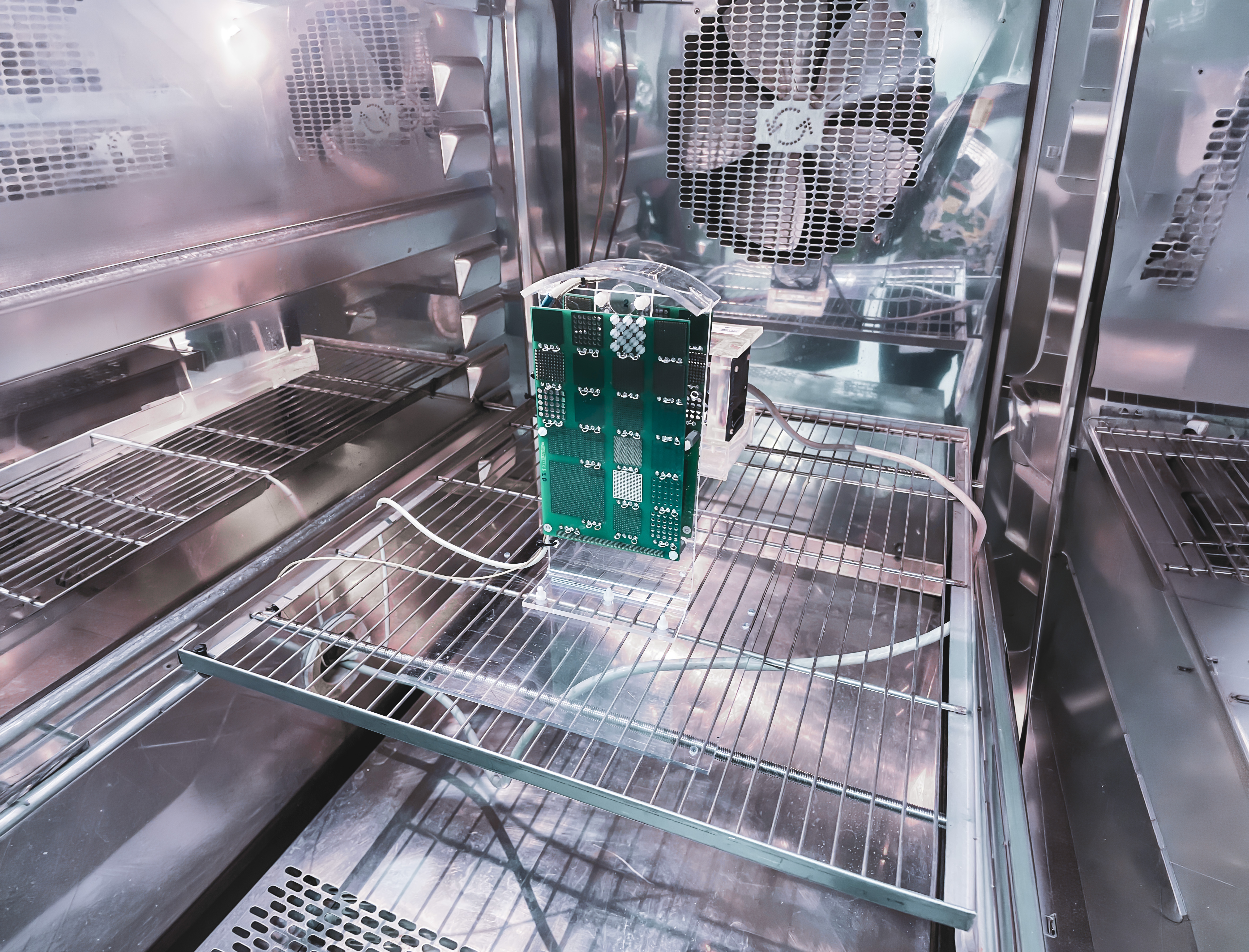
Moisture level indicator consultancy gives clearer insight into humidity exposure in electronic products used in humid environments. A moisture level indicator integrated in the PCB measures absorbed moisture in the board and can indicate the risk of humidity- and corrosion-related problems. The resulting data provides product-specific insight into moisture conditions during operation and supports evaluation of product robustness and service decisions within electronic product compliance.
Challenges
When moisture inside the PCB cannot be measured directly, humidity-related degradation mechanisms become difficult to interpret and manage.
Hidden moisture uptake increases corrosion risk
Moisture absorbed inside the PCB can drive corrosion and leakage paths in electronic assemblies, but this internal condition is not visible through measurements of ambient humidity alone.
Ambient humidity measurements give incomplete insight
Environmental humidity sensors measure humidity in the surrounding air but do not show how much moisture has been absorbed by the PCB material.
Uncertain moisture exposure complicates design decisions
Without knowledge of actual moisture uptake in the PCB, it becomes difficult to evaluate whether electronic products are appropriately dimensioned for humid environments.
Limited product-specific data weakens service decisions
When moisture exposure inside the PCB is not measured directly, decisions on service, repair or replacement must rely on assumptions or average environmental values rather than product-specific data.
Benefits
Use measured PCB moisture data to evaluate humidity exposure and support product-specific decisions
Product-specific moisture measurements
An MLI measures absorbed moisture directly inside the PCB, providing data on the internal condition of the board rather than relying solely on environmental humidity measurements.
Identification of humidity and corrosion risk
Measured moisture levels inside the PCB can indicate when electronic products are exposed to conditions that increase the likelihood of humidity- or corrosion-related degradation.
Insight across multiple products
MLI data collected across a fleet of products enables comparison of moisture exposure between different operating environments or conditions.
