
Receive documented test results for a representative section of the bridge deck, which is particularly relevant for flexible bridge structures such as suspension bridges and cable-stayed bridges. Depending on the case, the output can include design loads such as drag, lift and moment (CD, CL & CM), aerodynamic stability limits for flutter and galloping, buffeting response and vortex-induced oscillations related to fatigue and user comfort. The results cover the aerodynamic behaviour of the deck and can be used to assess geometric modifications and remedial measures, such as dampers and guide vanes. The scope covers deck behaviour, not the full bridge's response.
Aerodynamics and wind engineering
Aerodynamic assessment of bridges for wind response
Assess wind response in bridge structures to support bridge design and erection-stage assessment for bridge designers and engineers.
Bridge aerodynamics becomes relevant when bridge designers and engineers work with long, light or flexible bridges during construction. Without a reliable basis for bridge wind response, design work can be delayed, and important aerodynamic questions can remain unresolved.
Wind response for design and erection stages
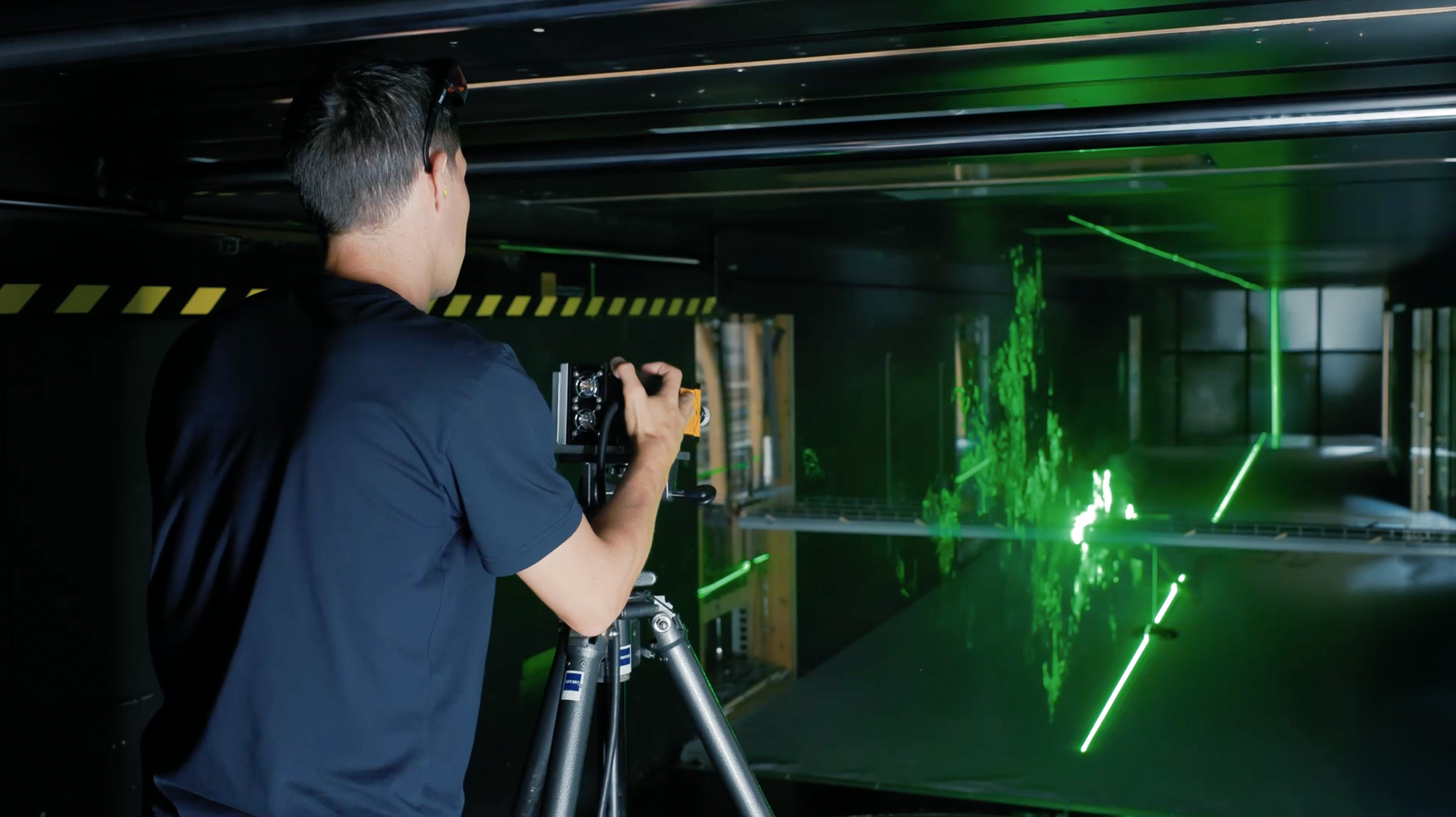
Our wind tunnel tests provide a documented basis for investigating aerodynamic behaviour, wind loading and site wind conditions in support of bridge design and safe erection. The service is part of a suite of aerodynamic test services.
Challenges
When bridge teams must predict wind response, unresolved aerodynamic behaviour delays design and erection.
Unclear deck response delays design work
When the aerodynamic behaviour of the deck is not documented, it is difficult to establish loads, stability limits, buffeting motions and vortex-induced motion within the design basis. This leaves uncertainty around the deck cross-section and whether geometric changes or remedial measures need investigation.
Vulnerable erection stages create uncertainty
During construction, reduced mass and stiffness can make the bridge more sensitive to wind than it is in the completed structure. For cantilevered cable-stayed bridges and suspension bridges under erection, uncertainty in this temporary condition can affect safe assessment during erection.
Free-standing pylons need separate testing
Before cables and deck are in place, a pylon can be exposed to lateral and torsional motion, as well as high base-bending moments. Without testing, the basis for assessing static deflection, dynamic response and possible aerodynamic instability is limited.
Complex terrain weakens the wind basis
Bridges in hilly or mountainous areas require representative local flow conditions. When local records are missing or distant data are not representative, the wind basis for design becomes less certain.
Benefits
Get test results and site wind input to support bridge assessment during design and erection
Establish a more representative wind basis
Project-specific study results provide a stronger basis for describing site wind conditions. This is applied when available meteorological data do not sufficiently capture local terrain and environmental effects.
