
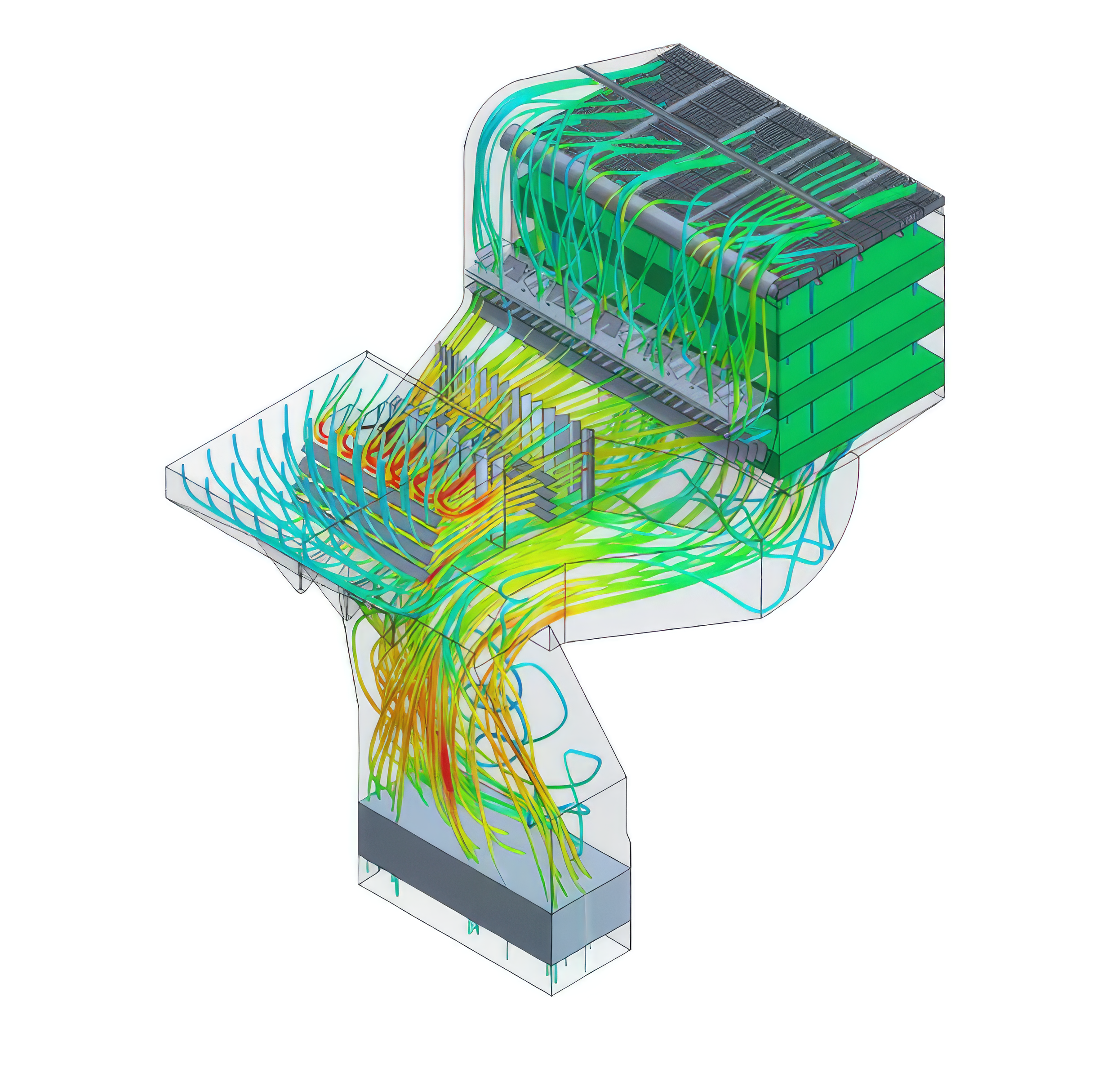
The service includes CFD analyses of full-scale 3D geometries built from CAD data, covering anything from a single unit to a complete system. Operating conditions can be included directly in the model, and design changes, such as guide vanes, injection systems or duct geometry, can be evaluated to improve flow conditions. The output is used to compare design options and document the effect of proposed changes.
Simulation and CFD for energy-, process- and production systems
Design and validation of flue gas cleaning using CFD
Improve flue gas cleaning performance with documented flow optimisation that supports design decisions and operation across varying loads and conditions.
Flue gas cleaning systems must discharge clean air and meet environmental requirements, but the performance of SCR, SNCR, FGD, scrubbers and filters depends on stable flow conditions inside the unit. Uneven velocity, temperature or mixing can reduce cleaning efficiency and affect overall system performance.
Improve the basis for design and optimisation decisions
Companies that need documented insight into flow conditions in existing or planned flue gas cleaning systems can use the analyses to evaluate and optimise system performance under defined operating conditions. Uneven flow distribution, unstable process conditions or unresolved pressure loss can create operational uncertainty and make it difficult to assess how the system will perform in practice. Documented flow analyses provide a clearer basis for evaluation and optimisation of flue gas cleaning systems. The service is part of our expertise area Simulation and CFD for energy-, process- and production systems.
Challenges
When flow conditions are uneven, operators risk reduced cleaning efficiency, unstable operation and poor design decisions.
Poor flow distribution reduces cleaning performance
When gas flow is uneven within the unit, the conditions required for chemical reactions, heat transfer and particle separation may not be present where they are needed. This can reduce the efficiency of the individual cleaning unit and weaken the performance of the wider system it is part of.
Inadequate mixing or injection affects process stability
If injection systems and internal mixing are not adapted to the actual geometry and operating conditions, cleaning substances may be used inefficiently, and process performance may vary with load. This makes it harder to assess whether the unit will function properly across expected operating conditions.
Pressure loss, erosion and dust build-up increase operational burden
Unfavourable flow patterns can create recirculation areas, local wear and dust accumulation. If these effects are not identified early, they can contribute to higher operational costs, shorter unit lifetime and avoidable modifications after installation.
Benefits
