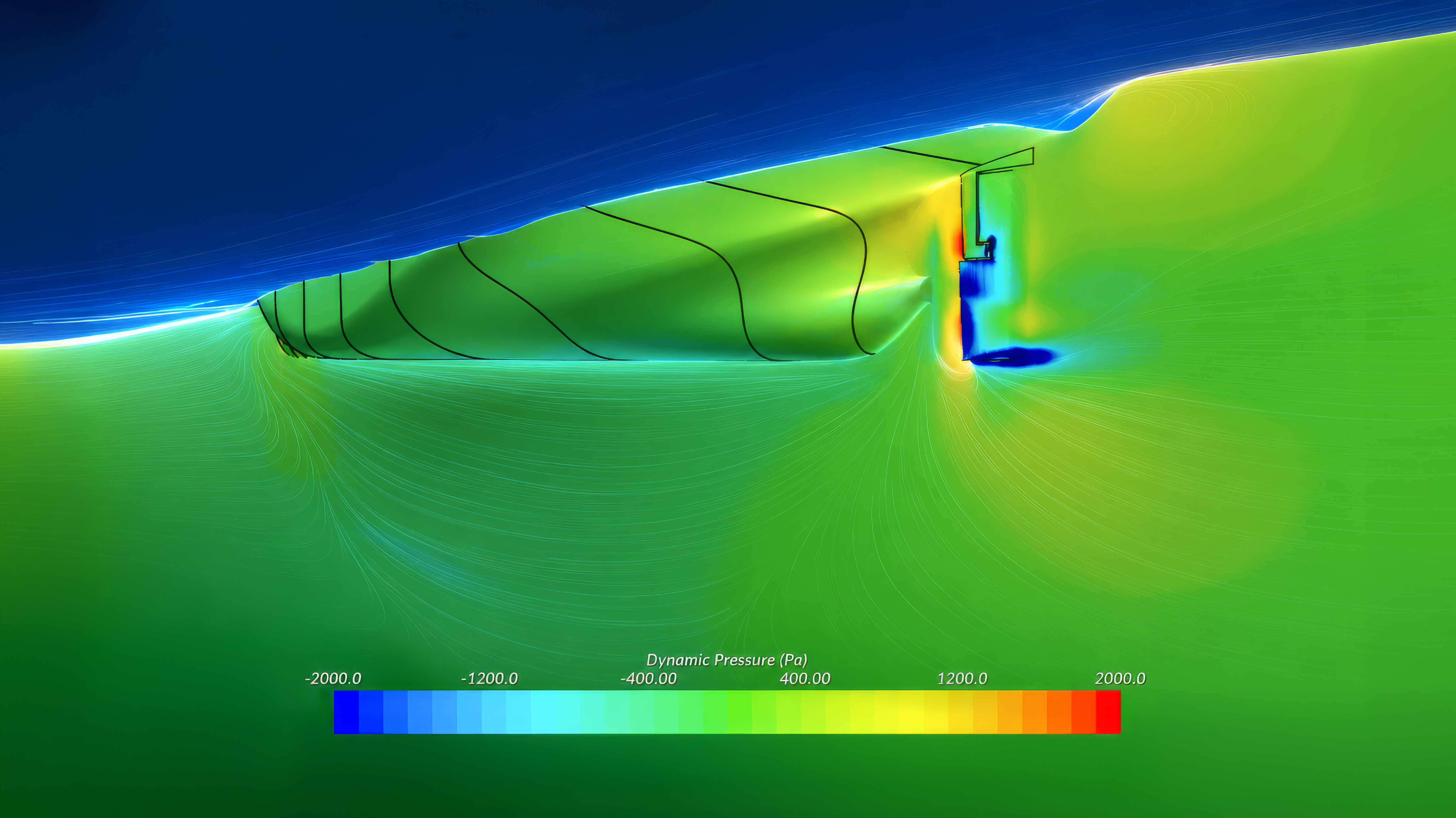
The service includes CFD calculations conducted as a numerical towing tank test, similar to a physical towing tank test. Computations are carried out at model scale, and full-scale results are derived using traditional scaling laws as if the data were from the towing tank. The deliverable includes calculation results for resistance, trim and flow features.
Maritime and offshore engineering
Hull line optimisation for ship design and modification
Get support to improve flow around the hull, propeller inflow and required speed
Hull line optimisation using Computational Fluid Dynamics (CFD) is relevant when a vessel design requires changes to the flow around the hull, the inflow conditions to the propeller, or wave-making. It is used in ship design and ship modification when hull geometry must be refined for the vessel's intended operation.
Operational need
The need typically arises when a vessel operates under a single condition or across multiple speeds and loading conditions. Without a structured optimisation process based on CFD calculations, it becomes difficult to assess hull changes against the intended operating profile and the design limits. Hull optimisation supports further design work by clarifying which hull changes should be taken forward. The service is part of our expertise area Maritime and offshore engineering.
Challenges
When a vessel must perform across multiple conditions, comparing and prioritising hull changes becomes difficult.
One design point can limit the optimisation result
When optimisation is carried out for only one condition or a narrow speed range, the result can be less useful for vessels that operate across a broader profile. This makes it harder to judge whether the hull form remains suitable outside the selected design point.
Several operating conditions are difficult to track
Vessels operating at different speeds and loading conditions require a broader overview of how hull forms perform. In a traditional optimisation process, this becomes difficult to manage, especially when design constraints must also be respected throughout the work.
Flow changes affect several performance factors at once
Changes to hull geometry influence the flow around the hull, wake properties, inflow to the propeller and wave-making. If these effects are not assessed together, it becomes harder to identify which changes should be carried forward in the design work.
Benefits
