
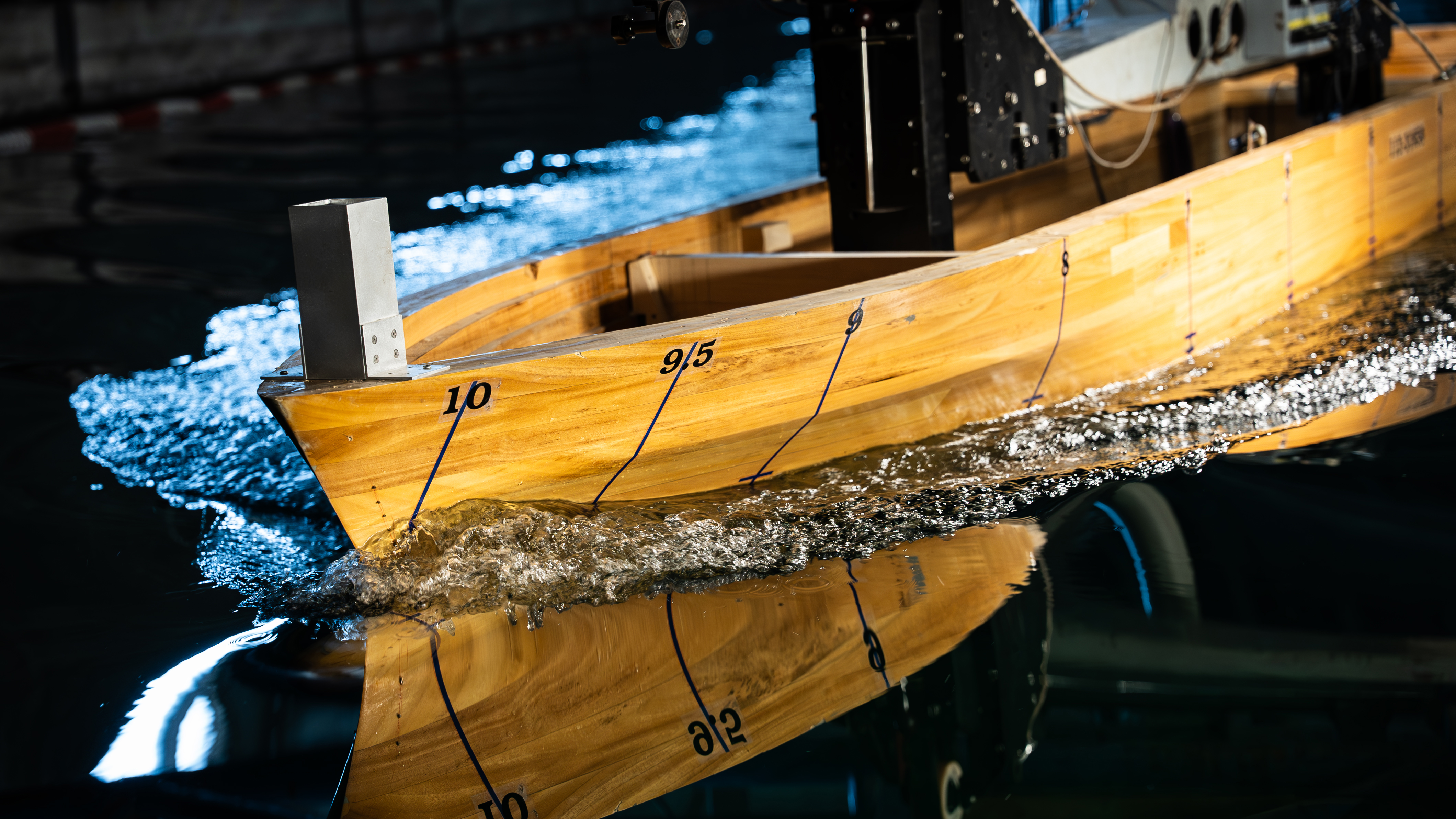
The service can include captive manoeuvring tests in the towing tank using Large Amplitude Planar Motion Mechanism. The customer receives measured PMM test data describing the vessel's manoeuvring characteristics in still water. These data are used to determine manoeuvring characteristics and can also serve as input to the numerical model used in the simulator. The scope covers captive model tests and associated data output, not full-scale sea trials or certification activities.
Maritime and offshore engineering
Vessel manoeuvring evaluation
Assess ship manoeuvring characteristics early, as new vessel designs are reviewed against relevant requirements.
Manoeuvring evaluation is relevant in the early design phase when a vessel’s manoeuvring characteristics must be assessed in relation to general IMO requirements and requirements linked to the vessel’s specific operation. If these characteristics are not clarified early, this creates a risk of later errors.
Early design relevance
The service supports clients who need documented insight into how a vessel is expected to respond in standard manoeuvres before the design is finalised. This makes it easier to decide whether the design should be examined further through testing, predictions or more detailed hydrodynamic calculations. The service is part of our expertise area Maritime and offshore engineering.
Challenges
When manoeuvring characteristics are not assessed early, vessel design can be delayed.
Unclear basis for selecting evaluation method
Without an initial understanding of manoeuvring characteristics, it is unclear whether evaluation should be based on model tests, prediction or more detailed hydrodynamic calculations.
Limited data weakens simulator preparation
When suitable manoeuvring data is unavailable, the numerical model description used in simulation has a weaker foundation. This makes later simulator preparation less certain and can limit the confidence with which vessel behaviour is represented.
Special hull forms need more detailed analysis
A hull form outside the main population represented in the PMM database may require more detailed hydrodynamic information. Without that, a standard prediction may not provide enough detail for the manoeuvring evaluation.
Benefits
Get documented manoeuvring results that support technical review, simulator preparation and comparison with IMO criteria
Review standard manoeuvres with documented results
Results can be delivered in graphical and tabular form for 10/10 and 20/20 zig-zag, turning circle with 35 degrees of rudder, and crash stop. This gives teams documented results they can use to review vessel response and compare standard manoeuvres with IMO criteria.
