
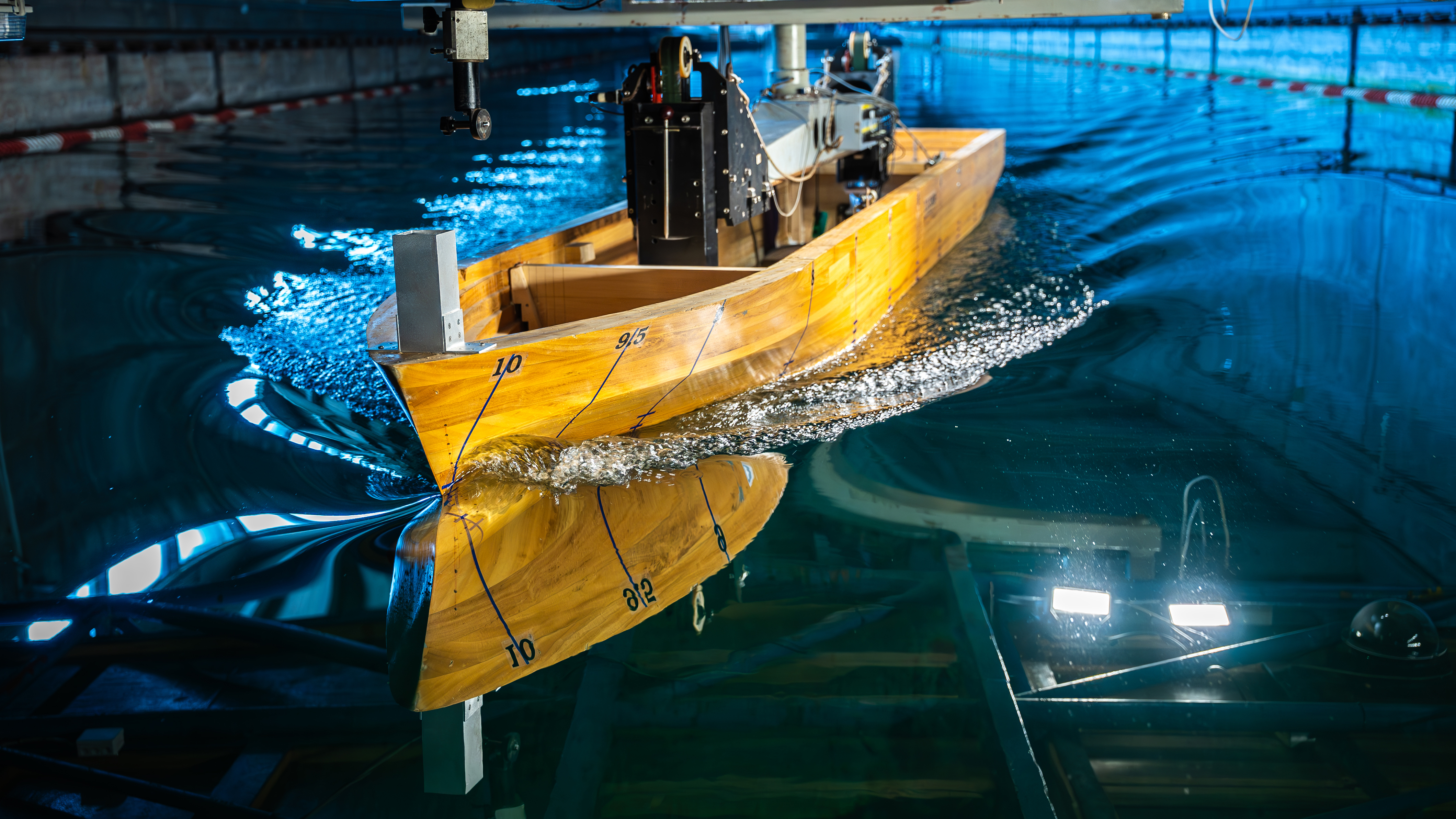
The service includes model tests conducted with a propulsion system that matches the real vessel's. The test set-up can cover conventional propellers, advanced waterjet systems and POD propulsion systems, with one to five propulsion units installed. Tests are performed in a large, deep-water towing tank or in a shallow-water manoeuvring basin, depending on the required test conditions. This part includes the physical test arrangement, the selected propulsion configuration and the use of the relevant test facility.
Maritime and offshore engineering
Evaluation of vessel performance
Support ship designers and naval architects when vessel performance must be assessed for design work or related to a contract.
Performance evaluation supports ship designers and naval architects when a vessel design must be assessed against contract requirements or when speed and required power must be estimated early in the design phase. The need typically arises during hull optimisation or when a new design must be assessed with its intended propulsion arrangement.
Performance clarity in early design
Without a clear basis for expected vessel performance, design work can be delayed by uncertainty about speed, required power and propulsion behaviour. The service gives project teams a clearer basis for design evaluation and contract-related performance assessment. The service is part of our expertise area Maritime and offshore engineering.
Challenges
When ship designers and naval architects lack reliable performance data, design and contract decisions can be delayed by uncertainty.
Unclear contract performance delays assessment
When a vessel must be assessed against contract requirements, uncertainty about expected speed, required power, and propulsion behaviour can make it difficult to judge whether the design is likely to perform as intended.
Limited early design data slows hull decisions
In the early design phase, hull review and optimisation depend on having reliable data for performance estimation. Without that basis, design choices can remain unresolved.
Different propulsion arrangements are hard to compare
Projects may involve propulsion systems with different numbers of propulsion units. Without comparable test data, it becomes harder to assess differences between arrangements.
Benefits
Get performance results and prediction data that support design work and contract-related vessel assessment
Use prediction results to evaluate design options
Prediction results for speed, required power and energy consumption provide a consistent basis for assessing different hull designs and propulsion arrangements. This supports early-stage design evaluation where alternatives must be compared using the same reference.
