105 members from 35 countries in ITTC work for maritime safety and fuel efficiency
ITTC develops global standards for energy-efficient and safe ship designs. FORCE Technology contributes with a 240m long towing tank for testing and optimisation of future ships.
Shipping forms the primary basis for global trade, and transport affects the prices and costs of almost all everyday goods. Sea transport is influenced by energy prices and environmental considerations, but safety for the vessel, crew, and cargo has always had the highest priority. ITTC works with the development of test standards for both energy efficiency and safety. FORCE Technology participates, along with 104 other test laboratories from around the world, in this work.
ITTC – International Towing Tank Conference
The organisation has members worldwide and it is all about ship design optimisation. Ships must be efficient, green, safe and manoeuvrable. A towing tank is a test basin where ship models can be evaluated and optimised in terms of energy consumption and movement during navigation in calm water or in waves. The 'conference' should be understood as the forum of test organisations that have access to such facilities and that participate with specialist knowledge about measuring propulsion conditions and manoeuvrability.
Constant improvement of maritime traffic
Sea transport is Denmark’s largest export industry. Denmark has a long tradition as a maritime nation and is internationally at the forefront regarding the green transition. A prerequisite for this includes the test standards developed by the organisation International Towing Tank Conference, ITTC. Denmark is represented in the organisation by FORCE Technology, and among the 105 members from 35 countries, Denmark has contributed since 1948 to ensuring that the more than 90-year-old organisation maintains and improves the test standards so that sea transport can take place as optimally as possible from technical and economic perspectives.
Through globally harmonised test standards, it is ensured that especially high-quality ships – such as those designed in Denmark – are not subjected to unfair competition from sub-standard countries. This is of crucial importance for Danish shipowners, shipyards and design houses as well as for the multitude of Danish subcontractors that support the shipbuilding industry (for example, main and auxiliary engine, pump, ship automation, ship electronics, navigation instruments, routing, and paint suppliers, among others).
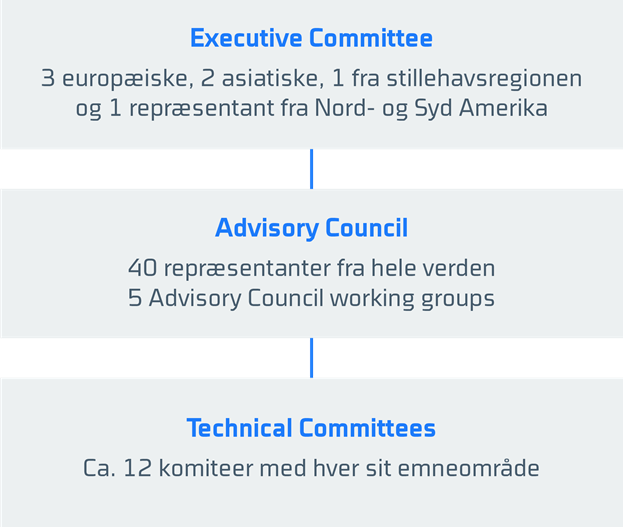
The conference is an organisation that works in three year sprints, during which specific issues are assessed and addressed in a wide range of technical committees. The technical committees, which are composed of members from many countries, have well-defined objectives prepared by the highest governing committees and approved by the organisation's general assembly every three years. All seven continents are represented on the Executive Committee. Under the Executive Committee is the Advisory Council, which oversees and manages the work of the committees. The organisation is shown in Figure 1.
The ITTC conference was recently held in September 2024, and thus the tasks for the coming three years have been established. The Advisory Council is responsible for maintaining progress so that results and conclusions are available to present at the next conference in 2027.
Figur 1: Struktur af ITTC
From Denmark, FORCE Technology participates in the Executive Committee and the Advisory Council and is also a member of the technical committees on Manoeuvring and Propulsion. FORCE Technology provides the secretariat for the entire ITTC. In addition, there are committees on ice navigation, stability in waves, cavitation and propeller noise, water resistance, full-scale performance, seaworthiness, stability in waves, offshore engineering and more. A committee on wind-powered and wind-assisted ships has also been established, since interest in wind as a means of propulsion has grown in recent years as fuel prices and environmental considerations have become increasingly important.
World-leading maritime test laboratories (105 in total) participate
Members must be approved before admission to ITTC based on criteria regarding competencies and suitable facilities, i.e., testing or research capabilities in specialised areas. With access to navigation simulators, computational fluid dynamics (CFD), model testing, several wind tunnels, and a 240 m long towing tank located in Hjortekær near Kgs. Lyngby, FORCE Technology is a valued participant in these activities. Denmark's contribution to the organisation’s activities benefits shipowners and shipbuilders and maintains the possibility to evaluate new builds in the design phase before actual sea trials, which are always carried out before the finished vessel is put into use.
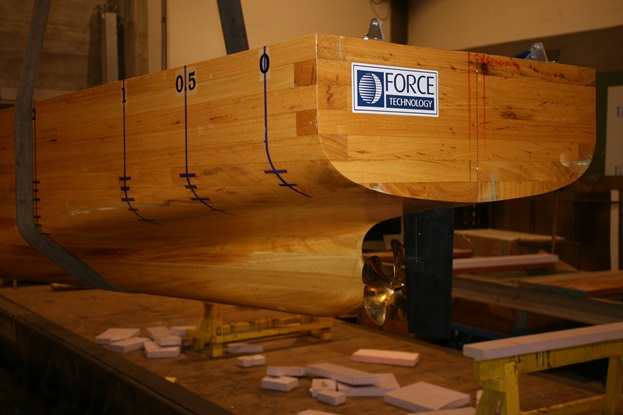
Physical experiments and trials are carried out with scale models of vessels, and different parameters such as the required engine power and water resistance under various wind and wave conditions are determined with high accuracy, which is crucial for the usability of the results. Even a deviation of a few tenths of a percent in estimated power requirements can have significant impact on the economic competitiveness of a ship design.
Modelforsøg til bestemmelse af fremdrivningsegenskaber udføres somforeskrevet i ITTC’s procedurer.
Three year action plans for development of procedures and guidelines
The work in ITTC takes place in three year sprints. At each conference, results and experiences from the previous period are presented, and decisions are made on which activities to prioritise in the coming period.
During the working periods, members of the individual committees meet about 10–12 times, typically once a year in person. The in-person meetings are hosted in turn by the members. This close collaboration facilitates knowledge-sharing, networking, and exchange of experience. The committees may also launch proficiency test programmes, which are comparative tests performed in the same way at several laboratories. This allows quality and uncertainties in tests and measurements to be quantified and compared. All technical committees also focus on CFD (Computational Fluid Dynamics) simulations and calculations, with continuous development of improved models and the use of increasingly powerful computer systems.
The project work results in a number of guidelines and harmonised procedures for how best to conduct testing and measurements in towing tanks and other test facilities. The guidelines are continually improved and updated with current experience as the test programmes progress. The Advisory Council is responsible for managing and monitoring activities throughout the three year process.
The work programme also includes benchmark testing, which enables refinement of processes and reduction of uncertainty in data and risk of misinterpretation. For each laboratory facility in member organisations, guidelines and procedures are integrated into the laboratory’s quality management systems, which also comply with the ISO 9001 standard.
Procedures and guidelines are also essential to cooperation with the International Maritime Organisation (IMO), which references these procedures and guidelines as a basis for approvals. The IMO’s 176 member states must, as part of their membership, implement IMO resolutions into national legislation so that vessels registered under their flags can comply with uniform requirements for safety and pollution. Denmark has been a member of the IMO since 1959. The IMO was established by the UN in 1948.
Energy efficiency, safety and smaller crews
Energy efficiency is an important area of work for ITTC. EEDI (Energy Efficiency Design Index) and EEXI (Energy Efficiency Existing Ship Index). The test and calculation procedures from ITTC are important for being able to calculate these indices. Energy consumption is a decisive factor for sea transport and is constantly balanced with pollution concerns – both air pollution and pollution from waste – with operational emission accounts being under intense scrutiny in recent years.
Alternative fuel types are therefore also included indirectly in ITTC's work, and these alternative fuels can offer significant environmental and CO2 advantages, but are much more expensive than those traditionally used. In recent years, fuels such as ammonia, hydrogen and methanol have come under consideration as alternative options, although prices are still several times higher than oil-based fuels. For both larger and smaller vessels, propulsion using renewable energy sources has become a real alternative that some shipping companies are trialling. There are experiments with traditional sails as propulsion, but also methods such as "rotor sails" in the form of Flettner rotors can be used as auxiliary propulsion. Flettner rotors consist of a tall cylinder rotated by a small motor on the ship. The rotation means that under certain wind conditions across the route, a propulsion effect can be achieved due to the so-called 'Magnus effect' caused by the interaction between the surface of the rotating cylinder and the wind. Scandlines has, for some years, used Flettner rotors on the ferry route between Gedser and Rostock. It also costs a small amount of energy to keep the rotor running, but overall, the effect is a gain in the energy balance. According to Scandlines’ own website, a reduction of 4–5% in CO2 emissions from the ferry operations is achieved.
Environmental and energy considerations mean that vessels are dimensioned very carefully today, to avoid over-equipping them with engine power and thereby achieving poorer energy indices. At the same time, the vessels must also be able to manoeuvre safely under extreme weather and operational conditions, such as a 50-year storm, so that there is no danger to crew, cargo, or the environment. Sufficient manoeuvrability is also important for navigation in ice-covered waters and has become a more pressing parameter as Arctic ice conditions are changing significantly and new, shorter routes may challenge safety if ice is present.
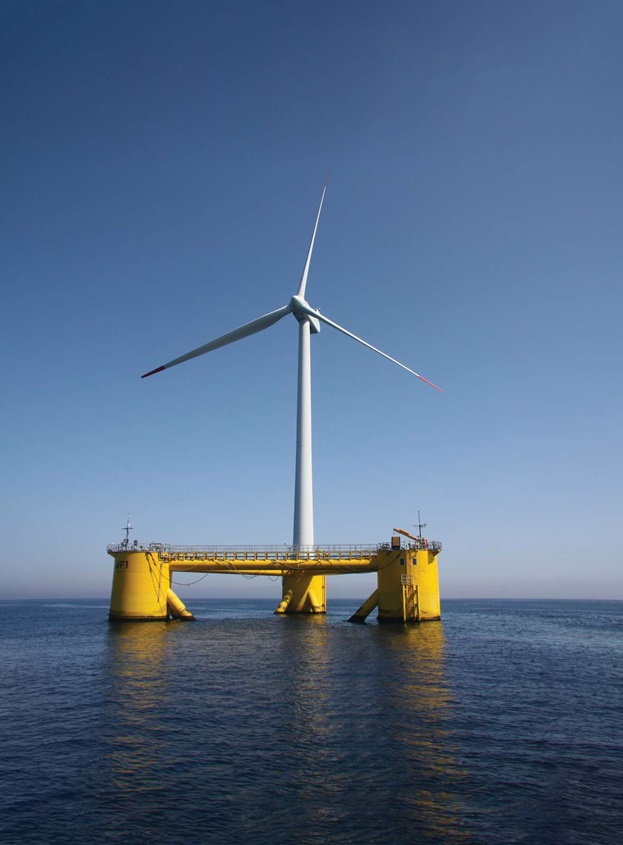
Flydende havvindmølle som eksempel på brugen af vedvarende energikilder i moderne maritime løsninger.
FORCE Technology’s role
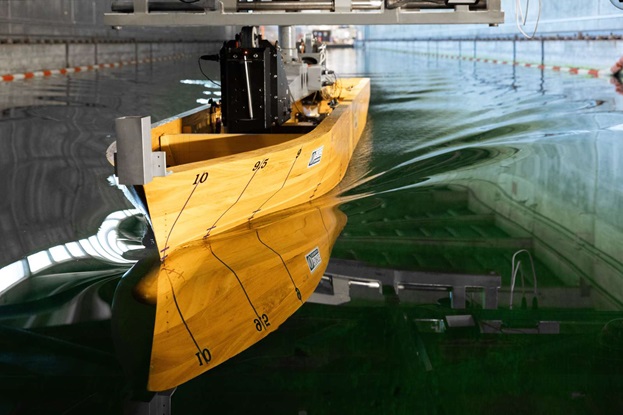
As noted, ITTC’s activities in standardisation fit well with several FORCE analysis activities. The 240-metre-long towing tank in Hjortekær, Kgs. Lyngby, is equipped with instrumentation and equipment so that towing tests can be performed with scale models built in its own workshop. The models are accurately scaled and can be flexibly adjusted during a test series. Forces during towing are measured for each test. The scaling of the model and of the parameters used in the towing tests is designed in accordance with ITTC recommendations and test procedures.
FORCE Technology also has wind tunnels where wind load on ships can be determined, and using an advanced wind simulation system, dynamic wind forces can be applied to the vessels in free running tests in the towing tank.
Accurate calculations and measurements in wind tunnels and towing tanks are essential for the development of mathematical models used in FORCE Technology’s simulators, which are employed at more than 45 simulation centres worldwide for design and crew simulation.
FORCE Technologys 240 meter lange slæbetank i Hjortekær til optimering af design og energieffektivitet.
ITTC Conference 2024
The conference was held in September 2024. Activities are outlined in the conference programme and in more than 800 pages of compendium material.
At the conference, results from the work in 13 specialist committees were presented.