
The article was published in the Danish magazine DSN SVEJSNING
At Force Academy in Norway, we believe that the future of NDT training will be far more accessible, individualised, and digital. At the same time, it is based on recognised learning methods and pedagogical approaches that provide learners with the greatest possible and most effective learning outcomes.
At Force Technology, we are focusing on the digitalisation of our course business by making Force Academy in Kristiansand, Norway, a "Centre of Excellence". The purpose is to consolidate and develop the future of digital education and thereby meet our customers’ needs in a far more flexible and customised way. Initially, this means that our NDT courses at Force Academy will be digitalised.
Digitalisation has a major influence on consumer choices, and speed and personalisation are increasingly decisive factors. This means that more industries and companies need to rethink products, services, and solutions to meet customer needs. Force Academy aims to support this process.
Limitations of traditional NDT courses
Traditional NDT training programmes are often characterised by one or more days of classroom teaching with large or small groups of students and an instructor.
This form of teaching requires students to be present at a specific time while all course content is delivered. As a result, the course is adapted to the group and may therefore include knowledge participants already possess before the course or knowledge they may never use. In addition, the teaching format is often limited to whiteboard instruction, group work, and/or practical exercises.
The course should adapt to the student – not the other way around
“As in many other industries, we see that our customers are requesting more flexible solutions so that teaching can better fit their daily work and needs. That is precisely why we have chosen to invest in digitalisation,” says Andreas Loland, Vice President at Force Academy, Norway.
One of the advantages of digital courses is that they provide a much higher degree of accessibility, flexibility, and individual adaptation for each participant. This also contributes to improved learning outcomes.
Andreas Loland continues: “The ambition is not only to offer greater flexibility. We also want to ensure better learning and improved learning outcomes for each participant, and this requires careful consideration of pedagogy, teaching methods, and course structure.”
Blended learning ensures flexible and individual learning
At Force Academy, blended learning is a key element in ensuring flexible and individual learning solutions for course participants. Blended learning means combining different forms of digital teaching with traditional classroom instruction. This provides several benefits for participants, who get a much more flexible and individually tailored course solution adapted to their needs and preferences.
Over the past two years, Force Technology has invested significant resources in developing digital learning. We have worked extensively with frameworks and pedagogy and tested a wide range of digital solutions. Subsequently, we have developed a series of e-learning courses, teaching modules and demonstration videos that have been internally tested and quality-assured before being trialled with course participants. Through this, we have gained unique insight into how effective learning solutions for the NDT profession can be established.
The digital learning circle defines the framework for each course
We have established an entirely new framework for our digital teaching approach. Through the concept of “the digital learning circle”, each course is analysed according to 6 parameters to determine the optimal balance between digital and classroom-based teaching for the individual course.
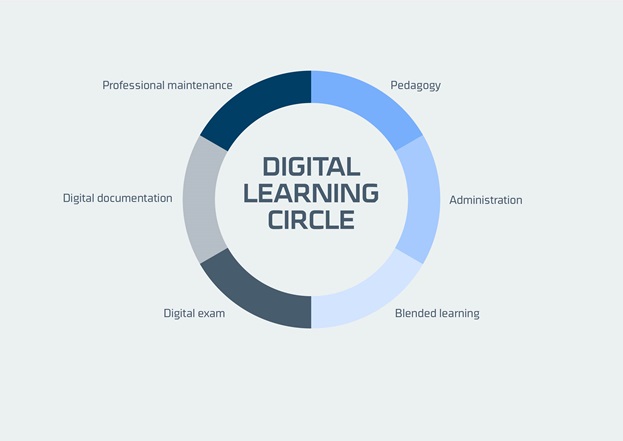
Step 1: Pedagogy
Force Academy uses a combination of experienced pedagogues together with education and competency requirements for all instructors. Course structures, frameworks, presentation formats, and teaching materials are designed by pedagogues to ensure good balance and varied learning. This helps ensure the best possible learning outcomes for participants. Competency requirements and instructor training ensure that the correct methods and tools are used within the established framework.
Step 2: Administration
Force Academy ensures that courses are administered and delivered within a strong learning environment. Through our digital administration systems, digital classrooms, and ongoing dialogue with instructors, course participants are supported throughout the entire educational process.
Step 3: Blended learning
Force Academy stays updated on the latest technology and solutions, enabling us to select the right learning tools and the appropriate balance between digital solutions and classroom teaching.
Step 4: Digital examinations
Force Academy conducts examinations digitally. When a course concludes with an examination, the examination format is assessed to ensure it functions optimally within the normative requirements of the certification scheme. After the participant has completed the examination, some parts are assessed automatically in our examination system, while others are reviewed by external examiners. The certification manager reviews all examination components as an additional quality assurance measure.
Step 5: Digital documentation
Force Academy issues digital course certificates, course materials, and certifications. This means that participants no longer need to manage paper documentation. For each course, the need for documentation and communication is assessed individually. Our systems also ensure that documentation is maintained and updated when required.
Step 6: Professional updates
In the near future, Force Academy will establish professional communities for all our courses. Here, participants will receive professional tips and updates, including ongoing access to free course modules. This ensures that all our participants receive the best possible education and continuous competence updates.
How is NDT training structured in practice?
From January 2021, we are offering an entirely new concept for NDT training, where each individual method is analysed according to the digital learning circle. This means that some courses will become 100% digital, while others will consist of 30% digital instruction and 70% classroom teaching.
In practice, all our NDT courses will begin with a digital module lasting 1–3 days, followed by classroom teaching lasting 1–8 days. Participants receive access to the digital module approximately 14 days before the course begins, allowing them to improve learning outcomes by acquiring subject knowledge before the course starts and creating time for repetition and immersion. At the beginning of the course, an instructor-led digital module starts, where participants use e-learning, video lectures, e-books, and other relevant learning materials. During the weekend, participants have time for self-study before classroom teaching begins on Monday morning with assignment-based learning, one-to-one instructional support and practical training in the relevant NDT method.
With this structure, we ensure that participants achieve better learning outcomes and a more flexible solution. Participants can review theory at their own pace, immerse themselves in selected topics and repeat content as needed. Throughout the course, participants also have continuous access to instructors for personal guidance. This ensures stronger professional development and a better understanding of the subject.
During classroom teaching, demonstration videos and personal follow-up from instructors help reduce downtime and improve learning.
Does it meet customer expectations?
When we began the digital development process in autumn 2018, our focus was on educating participants to become better inspectors. As with many change processes, some customers were sceptical, while others focused primarily on cost savings. However, they all shared a genuine desire for a solution that would strengthen inspectors’ professional competence.
Since then, after thorough analysis and implementation of blended learning solutions, we have received only positive feedback from our customers. Over the past six months, the Corona crisis has further confirmed our vision that the future is digital for all our courses. Most importantly, it works.
Andreas Loland concludes:
“The ongoing dialogue with our customers about their needs has been absolutely essential in enabling us to shape the education of the future. We firmly believe that the future of NDT training is digital because it is better adapted to customer needs in terms of accessibility, individualisation, and digital access.”
