Challenge
The existing noise barriers were too low to adequately protect nearby residential areas in Nyborg from rising traffic noise.
Solution
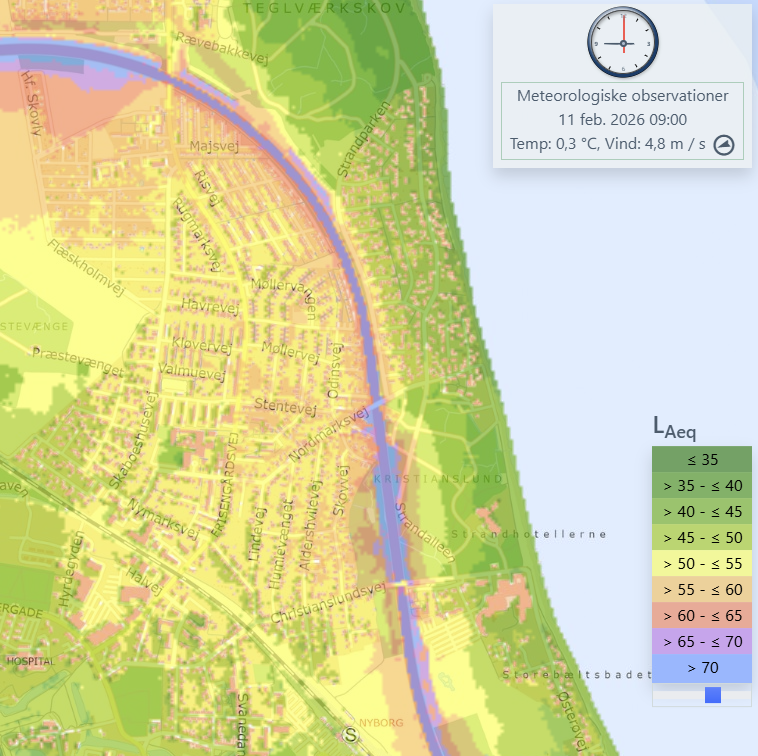
Real-time noise measurements and visualisation showed the motorway's noise impact, improving dialogue with the Danish Road Directorate.
Result
Nyborg Municipality documented excessively high traffic noise levels, which helped secure approval for new noise barriers.
Long-term traffic noise measurements documented the need for new noise barriers and opened the door to a more constructive dialogue with the Danish Road Directorate.
Traffic noise affected densely populated residential areas in Nyborg
Nyborg is one of the few towns in Denmark where the motorway runs only a few metres from residential areas. Despite existing noise barriers, the municipality had experienced a significant increase in traffic noise over several years, particularly in areas close to the motorway.
Per Jürgensen, environmental officer at the municipality of Nyborg, explains:
"We have experienced increasing traffic noise from the motorway for a long time. Some houses are only ten metres from the road, and residents reported that the noise kept getting worse, even at night."
Real‑time measurements provided the municipality with a stronger foundation
For years, the municipality had tried to engage the Danish Road Directorate and the Ministry of Transport in dialogue. Still, it was deprioritised each time because noise barriers were already in place. The municipality, therefore, decided to document the actual noise exposure experienced by residents.
FORCE Technology assisted in establishing the measurement system, while the municipality installed six noise monitors along the motorway and kept them running around the clock. FORCE Technology processed the data and turned it into graphs and an interactive noise map that both the municipality and residents could follow.
Erik Thysell, Senior Specialist in acoustics, noise and vibration, led the work:
"It can be challenging to communicate noise conditions to residents, because technical terms such as dB and LDEN are not necessarily familiar.
Traditional calculations rely on statistical averages, but our dynamic noise map provides a more direct and intuitive picture of the noise experienced. It makes communication easier and builds greater trust in both calculations and decision‑making processes."
The documentation created a breakthrough in the dialogue with the Danish Road Directorate
FORCE Technology compiled the measurement results into a final report, which proved crucial for the dialogue with the Danish Road Directorate.
"They were very interested and receptive to the material we presented," says Per Jürgensen.
In December 2025, the municipality of Nyborg received funding from a national grant for new noise barriers.
"We believe that this project was one of the reasons we were prioritised," says Per Jürgensen.
New noise barriers will provide quieter nights
The new noise barriers will be constructed over the next 3 to 4 years and are expected to significantly reduce traffic noise.
"Residents should experience quieter nights in the future with the new noise barriers," Jürgensen concludes.
The municipality will continue noise measurements to monitor the long‑term development. The project has also strengthened cooperation between the municipality and local citizen groups, who actively participate in the dialogue about solutions to traffic noise.
.png)
