Get documented structural analysis for design, integrity and lifetime decisions in industrial components and structures.

Structural analysis supports companies, when components or structures must be verified, assessed or documented under real operating conditions. The need typically arises in design verification, remaining life assessment, damage assessment, lifetime extension or failure investigation, where decisions depend on actual structural behaviour.  


A documented technical basis

The service combines advanced simulation, analytical methods, direct measurements, standards-based assessment and engineering judgement to establish a clear basis for evaluation and follow-up. It can include Finite Element Analysis, fracture mechanics calculations, fatigue calculations, and structural measurements and monitoring for industrial components and structures across energy, offshore, manufacturing, infrastructure and process plants. The service is part of our Material science expertise area.

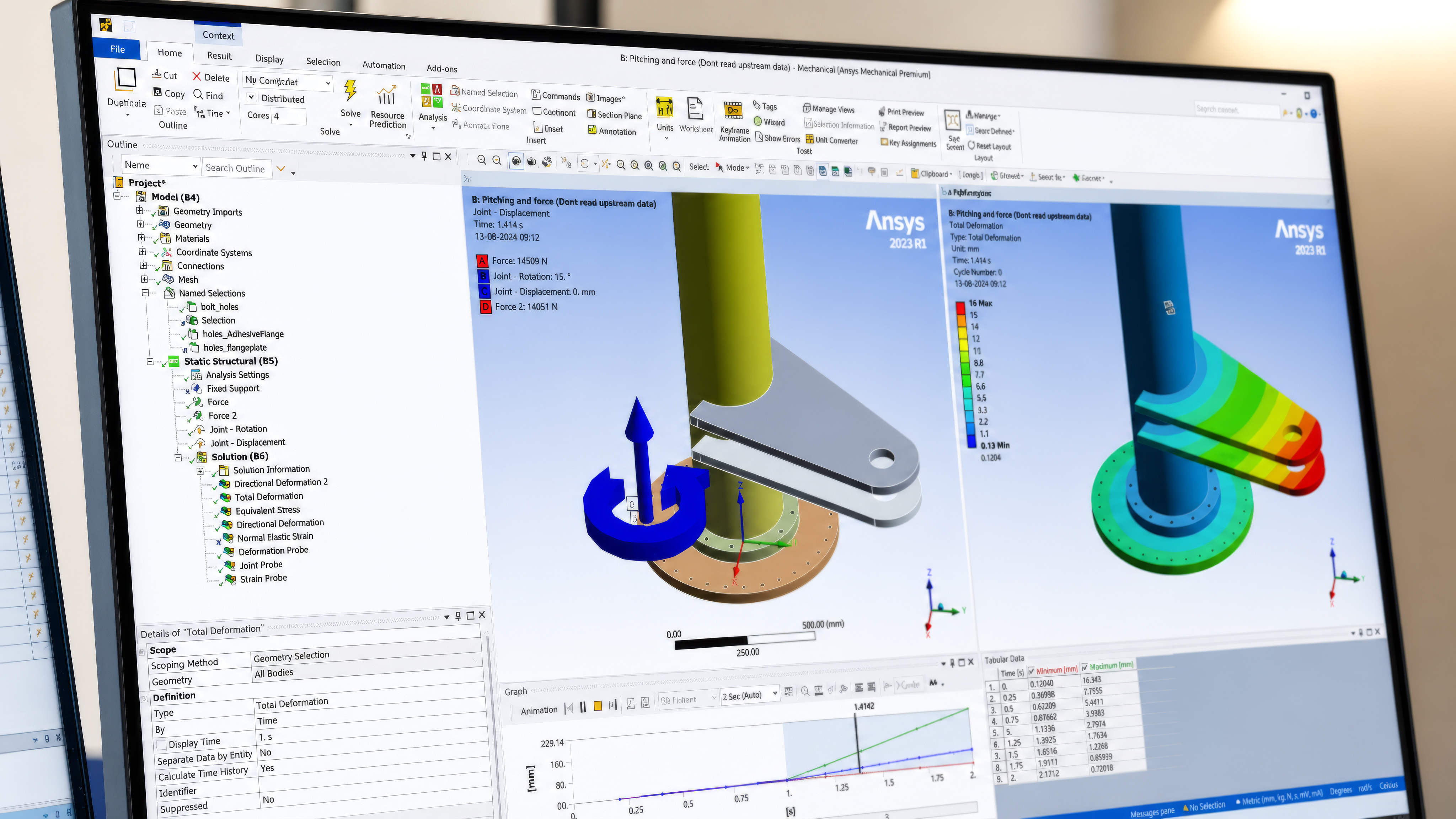
Computer screen displaying structural analysis software with a 3D model, deformation simulation and load distribution results for a mechanical component.
Finite Element Analysis, where a digital twin is used to evaluate structural behaviour and load distribution under operating conditions.

Challenges

When structural behaviour is not documented, engineering teams lack a reliable basis for design, repair and continued operation.

Missing assessment basis delays design verification 

When structural response is insufficiently documented, it becomes difficult to verify designs, assess existing structures, or justify deviations and nonconformities in a consistent way.  


Lack of defect knowledge blocks repair planning 

When defects, crack-like indications or fatigue damage are identified, missing information on size, location, loading or material properties makes it difficult to judge criticality and define repair or follow-up.  


Limited operating data weakens life assessment 

When actual loads, strain ranges, or vibration conditions are unknown, fatigue usage, monitoring needs and redesign of critical components are harder to relate to the real working environment. 

Benefits

Get documented assessment results for structural evaluation, follow-up and technical dialogue.

Document integrity on a clear technical basis

The output provides a documented basis for assessing structural behaviour under relevant loading conditions. This supports design verification, assessment of existing structures, and technical dialogue with clients, authorities and classification societies.