
The system operates on a 64/128-channel phased array ultrasonic testing platform supporting multi-probe operation. Time of Flight Diffraction channels run alongside phased array inspection for weld-root and through-wall defect characterisation together with pulse-Echo for transverse cracks. Phased array, ToFD, Pulse-Echo and high-resolution 3D surface data are acquired in a single workflow. Material thicknesses up to 150 mm can be inspected on typical monopile, tower and transition-piece sections. Other wind energy components may require methods such as wind turbine blade inspection.
Inspection and non-destructive testing (NDT)
Fast Ultrasonic Weld Inspection for automated inspection of welds in wind structures
Get automated weld inspection that supports continuous production and decision-making for wind energy manufacturing teams.
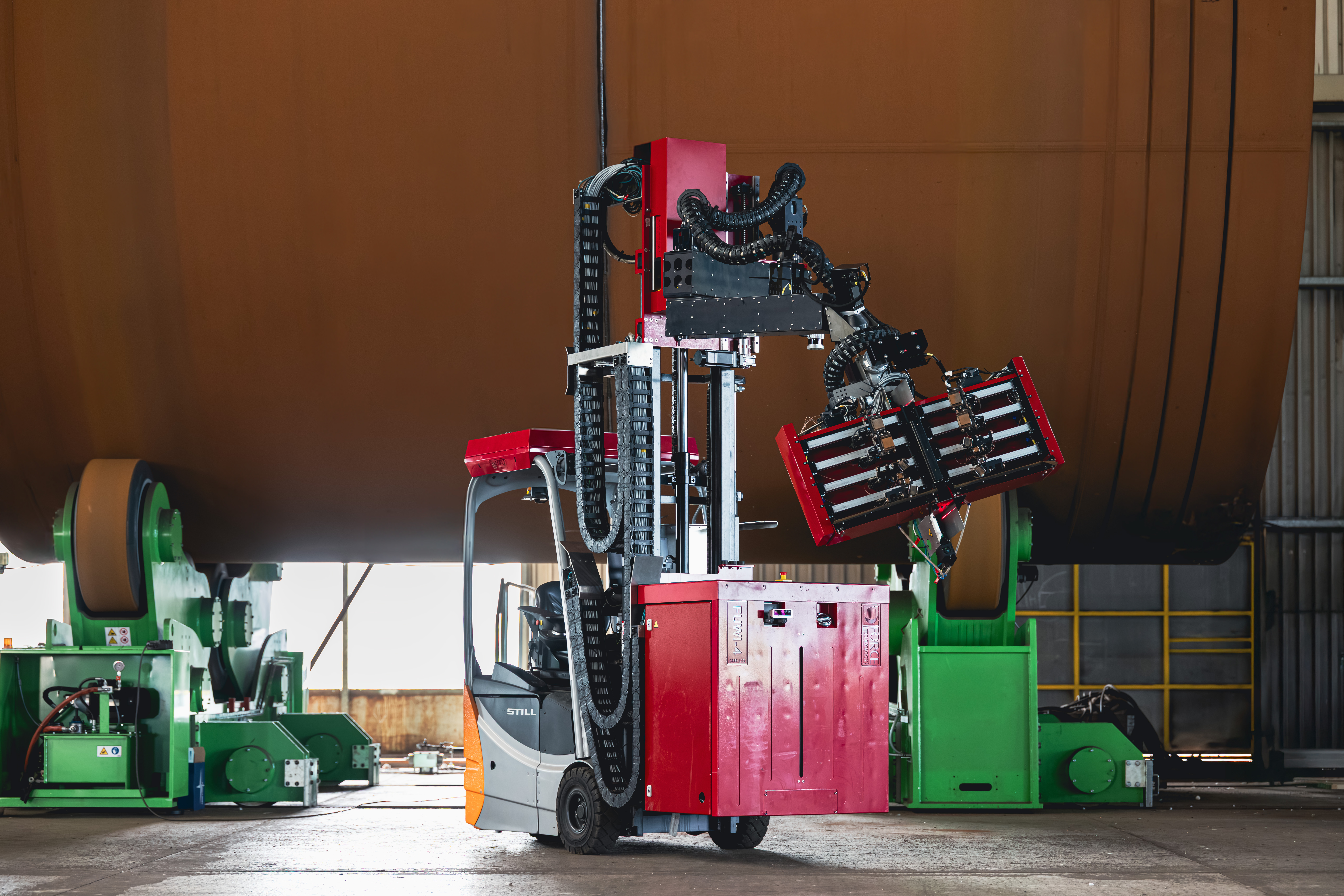
The Fast Ultrasonic Weld Inspection (FUWI) unit is an automated inspection solution used by production, quality and inspection teams in wind energy manufacturing where towers, monopiles and transition pieces are produced at scale. The need typically arises when weld inspection must keep pace with continuous production without slowing the flow of large structures through the line. When inspection depends on manual or semi-automatic approaches, limited capacity and delayed feedback can increase roller time, create bottlenecks and postpone corrective actions.
Automated inspection in continuous production
By allowing weld inspection to be carried out as components move through production, the product replaces uncertainty with consistent insight into weld condition and geometry. This helps teams maintain throughput, reduce delays and document weld quality throughout fabrication. The service is part of our expertise area Inspection and non-destructive testing (NDT).
Challenges
When weld inspection becomes a bottleneck in production, uncertainty disrupts flow and delays corrective actions for wind energy manufacturing teams.
Manual inspection slows production flow
Manual or semi-automatic weld inspection is time-consuming and often cannot keep pace with continuous production, increasing roller time and creating bottlenecks as large structures move through the line.
Limited inspection capacity delays feedback
Dependence on qualified NDT operators that are difficult to recruit can delay inspection results, leaving production and quality teams without timely input to address weld issues.
Inconsistent inspection data increases uncertainty
Variation in manual inspection approaches can lead to inconsistent information on weld condition, making it harder to assess quality and decide when corrective actions are needed.
Delayed corrective actions increase risk and rework
When weld quality issues are identified late, corrective actions are postponed, increasing the risk of rework, production delays and disrupted fabrication schedules.
Let's make sure you have the right inspection setup
Share a few details about your fabrication setup to receive a tailored quote and an outline of how automated weld inspection can be integrated into your tower, monopile and transition-piece production.
Standards
