Verify cable reaction-to-fire performance under the Construction Products Regulation through testing and assessment performed by a Notified Testing Laboratory supporting CPR classification and CE marking documentation.
CPR cable testing supports quality, regulatory and product compliance teams when cables are placed on the EU market for permanent installation in construction works such as buildings, roads and bridges. The scope includes electrical power cables, control cables and data communication cables, including optical fibre cables, that form part of the fixed installation in buildings.
Testing framework and classification
Under the Construction Products Regulation, cables used in construction works must demonstrate defined reaction-to-fire performance and be CE-marked before they can be legally placed on the EU market. Cables are classified according to CPR reaction-to-fire classes ranging from Aca to Fca, including additional parameters related to smoke production and acidity where applicable.
Testing outputs and conformity context
Testing measures characteristics such as flame spread, heat release, smoke production and acidity of combustion gases. The results may be used as evidence within the CPR conformity assessment framework, including type testing and Factory Production Control (FPC) and provide documented reaction-to-fire performance for technical documentation, Declarations of Performance and CE marking procedures.
Manufacturers are responsible for completing the conformity assessment procedure before affixing the CE mark. Importers placing cables on the market under their own name are subject to the same obligations. The service is part of our expertise in electronic product compliance and also includes, for example, testing LAN cables.
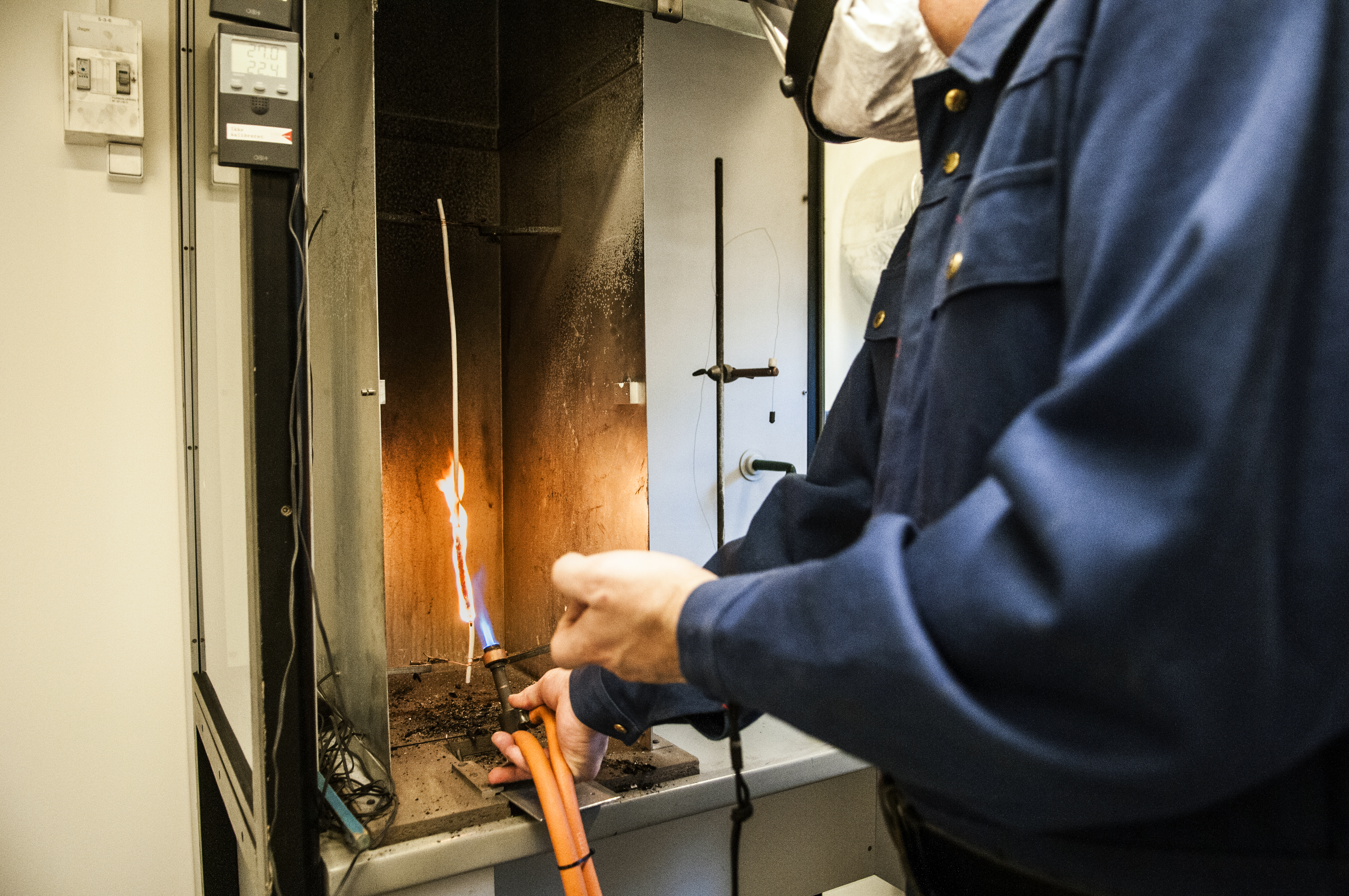
Reaction-to-fire testing of an electrical cable performed to determine CPR fire classification for cables used in construction works.
Challenges
When cables are used in construction works, incomplete reaction-to-fire testing or documentation can prevent correct CPR classification and delay CE marking procedures.
Fire, smoke and acidity test results are difficult to align
Reaction-to-fire classification is based on several interrelated tests. When results across flame spread, heat release, smoke and acidity are inconsistent or incomplete, the combined test evidence cannot be used to establish a valid CPR classification.
Cable design changes invalidate previous test results
Changes in materials, insulation compounds or cable construction may fall outside the configuration covered by existing CPR test evidence. This requires new testing before the reaction-to-fire classification can be documented.
Without traceable test reports, the reaction-to-fire classification cannot be documented and the Declaration of Performance cannot be issued.
Book a meeting with a CPR cable testing specialist
Discuss reaction-to-fire testing for power, control and communication cables under the CPR. Contact our specialists regarding testing and assessment of cables.
Standards
Accredited testing under the Construction Products Regulation
Benefits
Get documented reaction-to-fire test evidence supporting CPR cable classification and CE marking procedures.
Documented reaction-to-fire performance for cable classification
Testing provides measured fire performance data used to determine CPR reaction-to-fire classes Aca to Fca in accordance with EN 13501-6.
Consistent evidence across required CPR fire tests
Fire, smoke, and acidity characteristics are determined using defined test methods in the CPR classification framework.
Traceable documentation for CPR technical files
Test reports provide structured documentation describing cable reaction-to-fire behaviour for inclusion in technical files and Declarations of Performance.
Service scope
Technical foundation for CPR cable assessment
CPR cable testing is performed within the framework of the Construction Products Regulation (EU 305/2011). The regulation applies to cables intended for permanent installation in construction works that require reaction-to-fire performance to be documented.
The scope includes electrical power cables, control cables, data communication cables, and optical fibre cables that form part of fixed building installations.
Testing evaluates how cables behave under fire conditions by measuring parameters such as flame spread, heat release, smoke production and acidity of gases generated during combustion.
These characteristics are defined in CPR test standards and serve as the technical basis for the reaction-to-fire classification of cables installed in buildings and infrastructure.
Reaction-to-fire performance is classified according to EN 13501-6, which defines CPR cable classes from Aca to Fca.
Additional classification parameters may include smoke production, flaming droplets and acidity, depending on the results of supplementary tests.
The harmonised product standard EN 50575 defines requirements for conformity assessment of cables under CPR. This framework includes type testing and Factory Production Control (FPC), which manufacturers must maintain to ensure that cable production remains consistent with respect to reaction to fire performance .
Testing for the Construction Products Regulation (EU 305/2011) is performed in DANAK-accredited laboratories.
Force Technology acts as a Notified Testing Laboratory (NB 0199) for assessment of cable reaction-to-fire performance.
Where product certification under CPR is required, Force Technology works together with the Notified Product Certification Body FORCE Certification A/S (Notified Body No. 0200). Certification activities are carried out independently by FORCE Certification.
Defines a large-scale test method for measuring heat release and smoke production from vertically mounted cables exposed to flame.
Specifies a test method for determining flame spread on a single insulated cable exposed to a defined ignition source.
Defines a method for determining the amount of halogen acid gas released during combustion of cable materials.
Defines methods for measuring acidity and conductivity of gases produced during combustion of cable materials.
Defines a test method for measuring smoke density generated during cable combustion.
Defines the harmonised product standard for power, control and communication cables subject to reaction-to-fire requirements under the Construction Products Regulation.
Specifies the classification procedure for cables based on reaction-to-fire test data. The standard defines classes from Aca to Fca and additional designations for smoke production, flaming droplets and acidity, forming the basis for CPR classification and Declaration of Performance.
EN ISO 1716 specifies a method for determining the heat of combustion of building products. The standard is part of the CPR reaction-to-fire framework, but is not supported by Force Technology for cable testing.