
Aerodynamics and wind engineering
Climatic wind tunnel for testing bridge cables
Document how bridge cables respond to wind, rain and ice in a climatic wind tunnel.
As bridge technology makes it possible to construct longer and lighter bridges, the limits for bridge spans continue to expand. This development means that cables on cable-supported bridges can be exposed to strong vibrations under certain climatic conditions in wind. The need for climatic testing arises when cable response must be documented before further work on the bridge cables can continue.
Weather conditions that affect cable behaviour
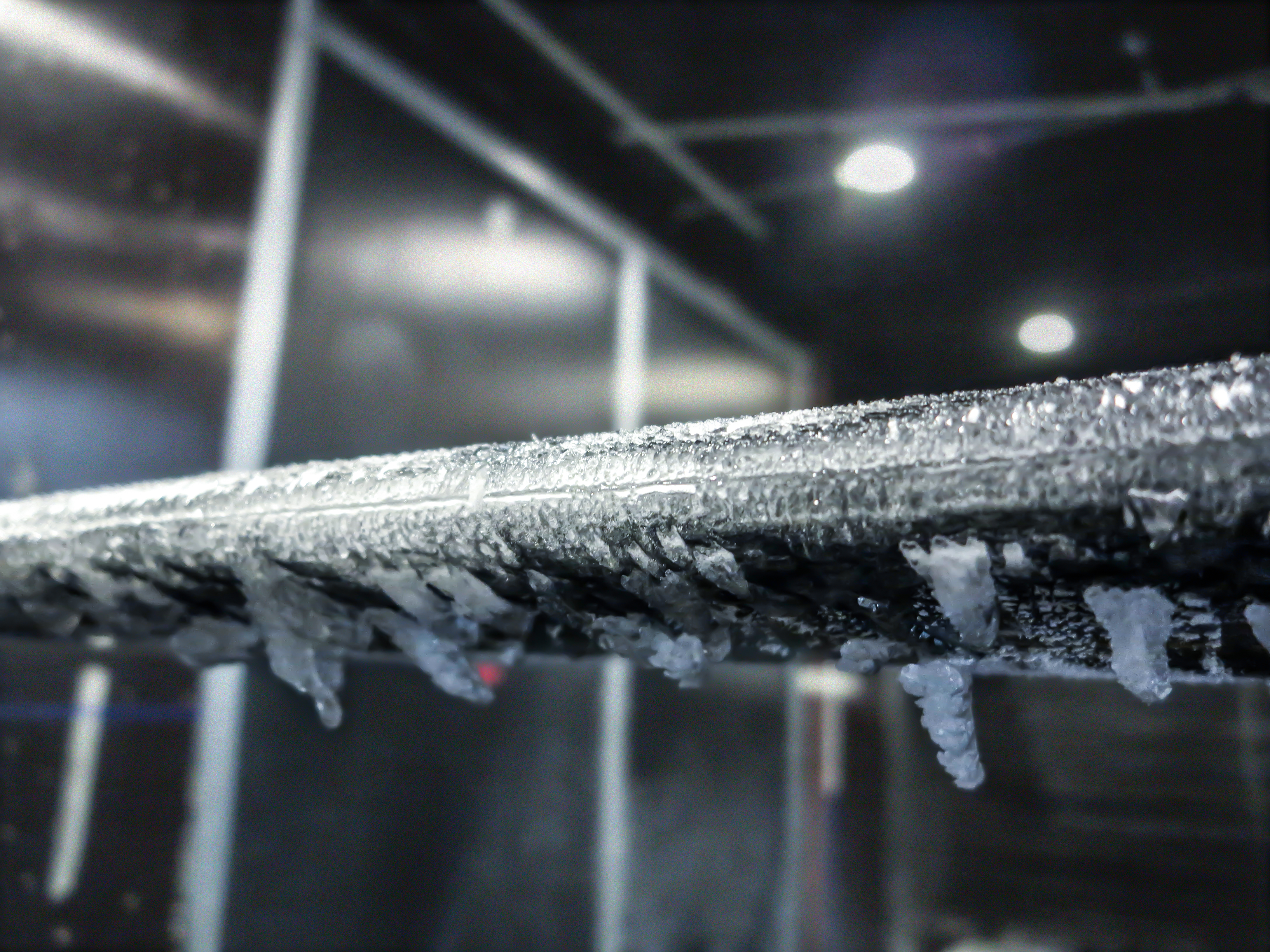
The climatic wind tunnel is used to test how bridge cables respond to weather conditions such as wind, rain and ice. One challenge in cold regions is ice accretion on bridge cables, because it can affect the aerodynamic properties of the cables and create a traffic safety issue if ice falls from the cables onto the roadway. By documenting cable response under these climatic conditions, the facility provides a technical basis for assessing which measures are required in further work on bridge cables.
Target group and benefits
Supporting bridge designers with documented cable response under climatic conditions for assessment and further bridge cable design work.
For bridge designers
The facility supports bridge designers working with cable-supported bridges when cable behaviour must be documented under climatic conditions. It is relevant when wind-induced vibration, rain exposure or ice accretion may affect cable behaviour and the aerodynamic properties of the cables. In these situations, designers need documented test results that show how the cables respond under defined climatic loading.
Documented results for further work
The tests provide realistic results and data that designers can use in further work to improve bridge cables. This gives a documented basis for technical assessment when cable response under wind, rain or ice must be understood before measures are selected. The outcome is practical support for bridge cable evaluation where climatic conditions are part of the design problem.
Discuss climatic testing of bridge cables
Contact our aerodynamics specialists to discuss testing of bridge cables in wind, rain and ice, and how documented cable response can support bridge cable assessment.
Facility specifications
Providing full-scale cable test capacity, wind speeds up to 32 m/s and controlled low temperatures.
Test section 2.0 x 2.0 x 5.0 m
Provides space for testing sections of cables in full scale. This is important because weather conditions such as rain and ice do not provide reliable results when assessed with scaled models.
Maximum wind speed 32 m/s
Makes it possible to expose bridge cables to high wind speeds so cable response can be documented under demanding climatic conditions.
Temperature to -5°C at 25 m/s
Supports combined testing with low temperature and substantial flow velocity when cable behaviour must be assessed in cold climatic conditions.
Temperature to -10°C at lower velocities
Enables testing at lower temperatures when reduced flow velocity is required for the climatic condition being assessed.
Facility designed for full-scale cables
The climatic wind tunnel is sufficiently large and designed for full-scale cable sections, making it suitable for cable studies where realistic results and data are required for further design work.
