
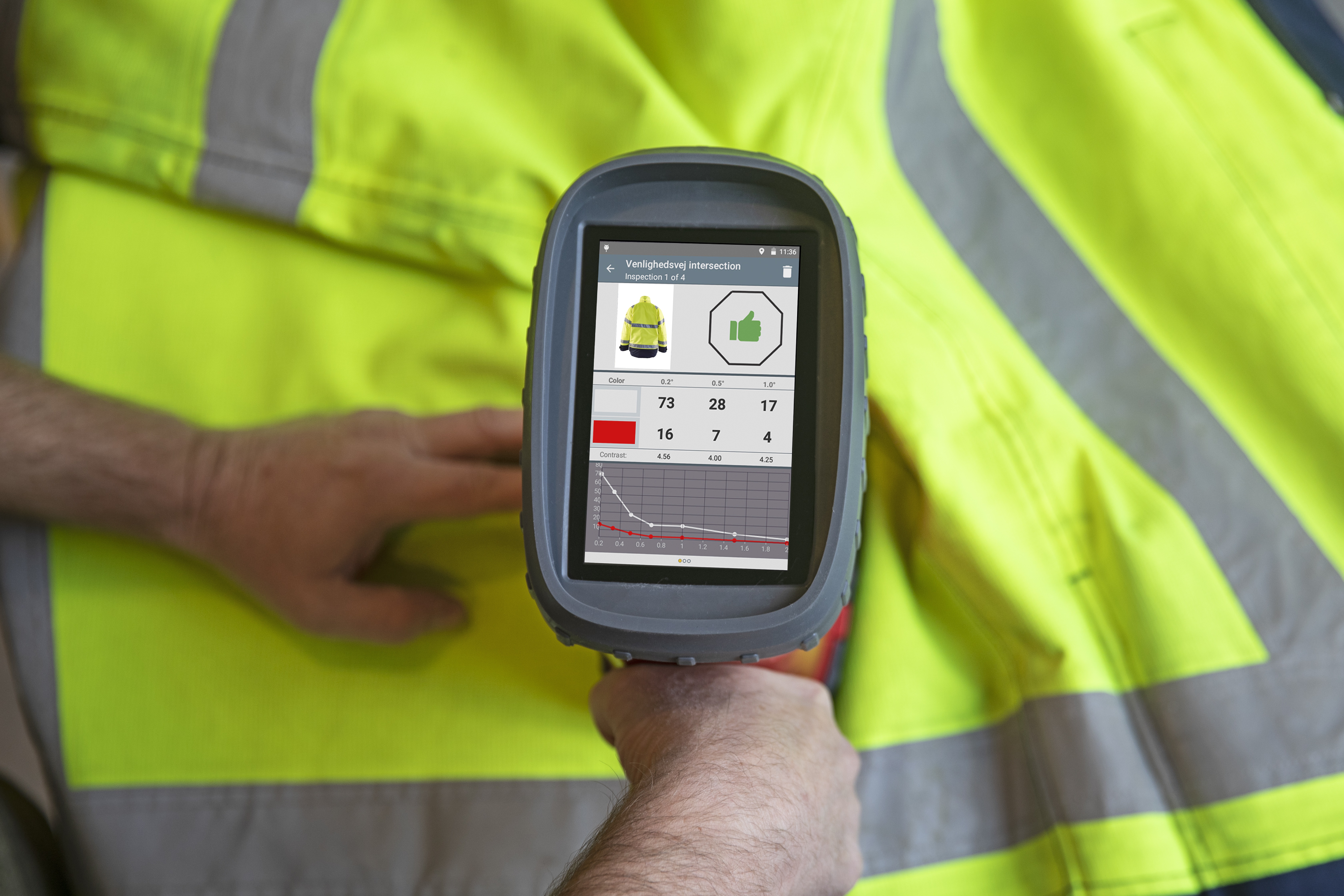
The service includes accredited and impartial testing of core parameters for retroreflective materials and sheeting. Depending on the application, testing can include the coefficient of retroreflected luminance (RL), the luminance coefficient under diffuse illumination (Qd) and the coefficient of retroreflection (RA). The tools and methods are used to quantify retroreflection, luminance and brightness as objective measurements for evaluation and comparison.
Lighting, optics and photonics
Accredited tests of retroreflective materials and sheeting
Get accredited testing of retroreflective materials and sheeting to verify compliance with relevant standards and document measured properties.
Retroreflective materials and sheeting are used in many products and applications for safety reasons. They are used in traffic and transportation, consumer products, aerospace and other areas where visibility and reflective properties need to be measured and assessed. Accredited testing is part of our suite of photonics services, and is used to verify whether materials meet relevant standards and to generate objective measurement data for the properties evaluated.
When testing becomes relevant
The need typically arises when materials must be evaluated against standards, when manufacturers need to control product quality, when different materials or coatings must be compared in development work, or when the effect of weathering, dirt accumulation or damage must be assessed. Without reliable measurements, it becomes more difficult to document reflective properties and to evaluate material performance consistently.
Challenges
When reflective properties must be documented, missing measurement data makes evaluation against standards and specifications more difficult.
Missing control of properties creates incertainty
Manufacturers need measurements of properties such as retroreflection and colour characteristics to verify that materials meet the intended specifications during production.
Limited comparison data slows development work
When materials, coatings or manufacturing techniques are not measured on a common basis, it becomes harder to compare their performance, durability and cost-effectiveness.
Degradation over time creates uncertainty
Weathering, dirt accumulation and damage can reduce effectiveness, and without measurements, it becomes harder to assess when maintenance or replacement becomes relevant.
Benefits
Get documented measurement results that support the evaluation of reflective properties against relevant standards
Support control of product quality
Measurements of retroreflection, luminance, brightness and colour characteristics can be used to check whether materials meet the intended specifications. This supports consistency and reliability in production.
Compare materials on the same basis
Objective measurement data enables comparison of different materials, coatings and manufacturing techniques on a common basis. This provides documented input for research and development work.
