
The work includes review and use of the material needed to build the simulation basis: 2D drawings or 3D CAD of the room, building or other study object, baseline information on natural and forced ventilation, and available HVAC data such as flow rate, temperature and specific heat. This defines what is included in the simulation setup used for the assessment.
Simulation and CFD for energy-, process- and production systems
Ventilation design and HVAC optimisation using CFD
Assess airflow, HVAC ventilation conditions and ventilation design in rooms and buildings with CFD.
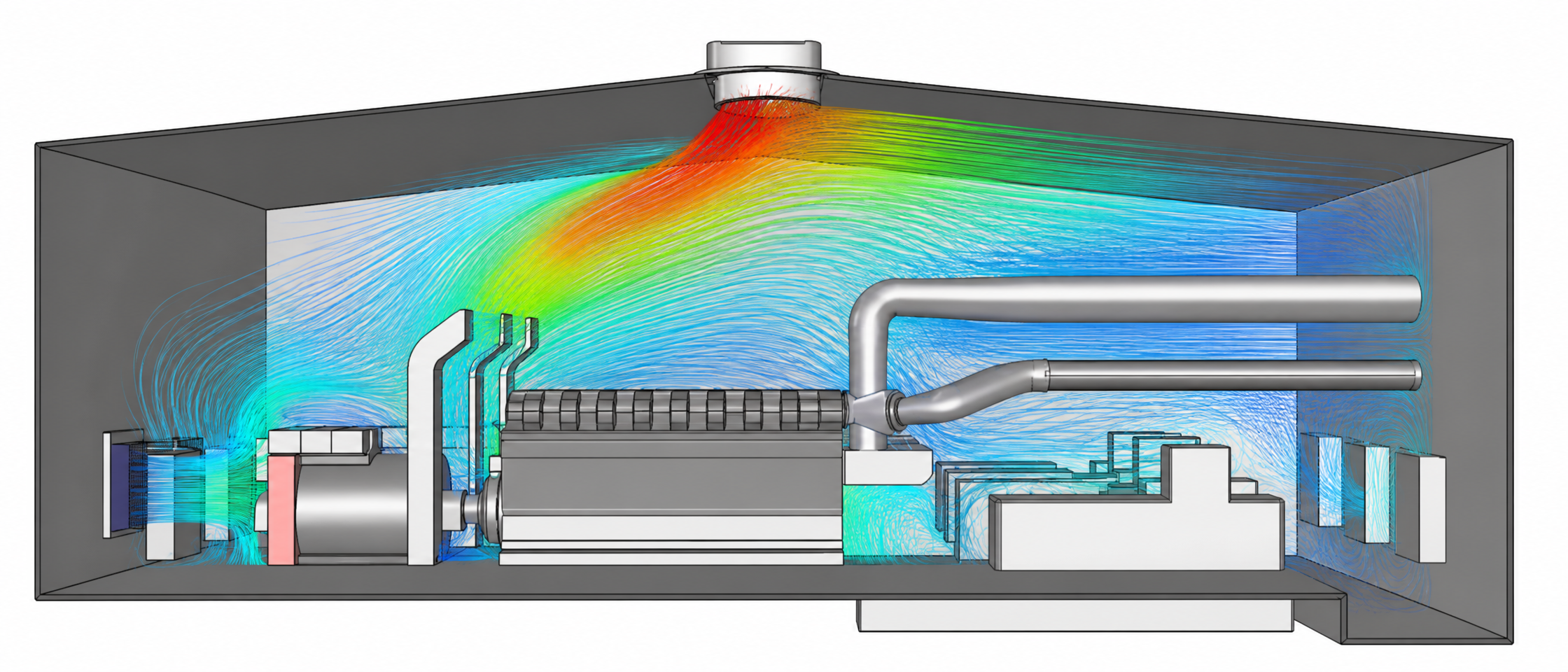
Design and validation of ventilation systems using CFD are used when a room or building must provide controlled air conditions suited to the intended use of the space. The need typically arises when airflow, temperature, humidity, gas concentration and HVAC performance must be evaluated in relation to room layout, occupancy and operational conditions. CFD analysis is used to assess airflow distribution and ventilation conditions in buildings, laboratories, industrial environments and rooms with specific indoor climate requirements.
Where ventilation becomes especially important
Without a detailed ventilation study, critical zones may be overlooked because average values do not show specific ventilation conditions. This is especially relevant in pharmaceutical and food environments, as well as in industries where harmful gases are unavoidable, because inadequately assessed ventilation issues can affect people, equipment and room safety. The service is part of our expertise area Simulation and CFD for energy-, process- and production systems.
Challenges
When ventilation systems must meet room-specific conditions, insufficient understanding of airflow and temperature distribution can create risk.
Critical zones remain hidden and affect room safety
Average calculations may not reflect local draughts, vortices, temperature deviations or gas accumulation. This can make it difficult to judge whether the room provides the intended air conditions.
Poor ventilation can affect hygiene, equipment and fire control
Ventilation problems can contribute to poor hygiene, the spread of infections, the inhalation of harmful gases, and unsuitable room temperatures. They can also increase the risk of damage to machinery or equipment and weaken controlled containment and spread in fire-related situations.
Incorrect HVAC sizing drives rework and cost
If ventilation performance is not assessed early, the selected HVAC system may be too large, too small or unsuited to the actual room conditions. This can increase capital and operating costs and may later require redesign, re-dimensioning or re-installation.
Need a ventilation assessment for your room or building?
Share your drawings or CAD model together with available ventilation and HVAC data. The assessment can be used to evaluate room conditions and support ventilation design choices before installation.
Standards
