
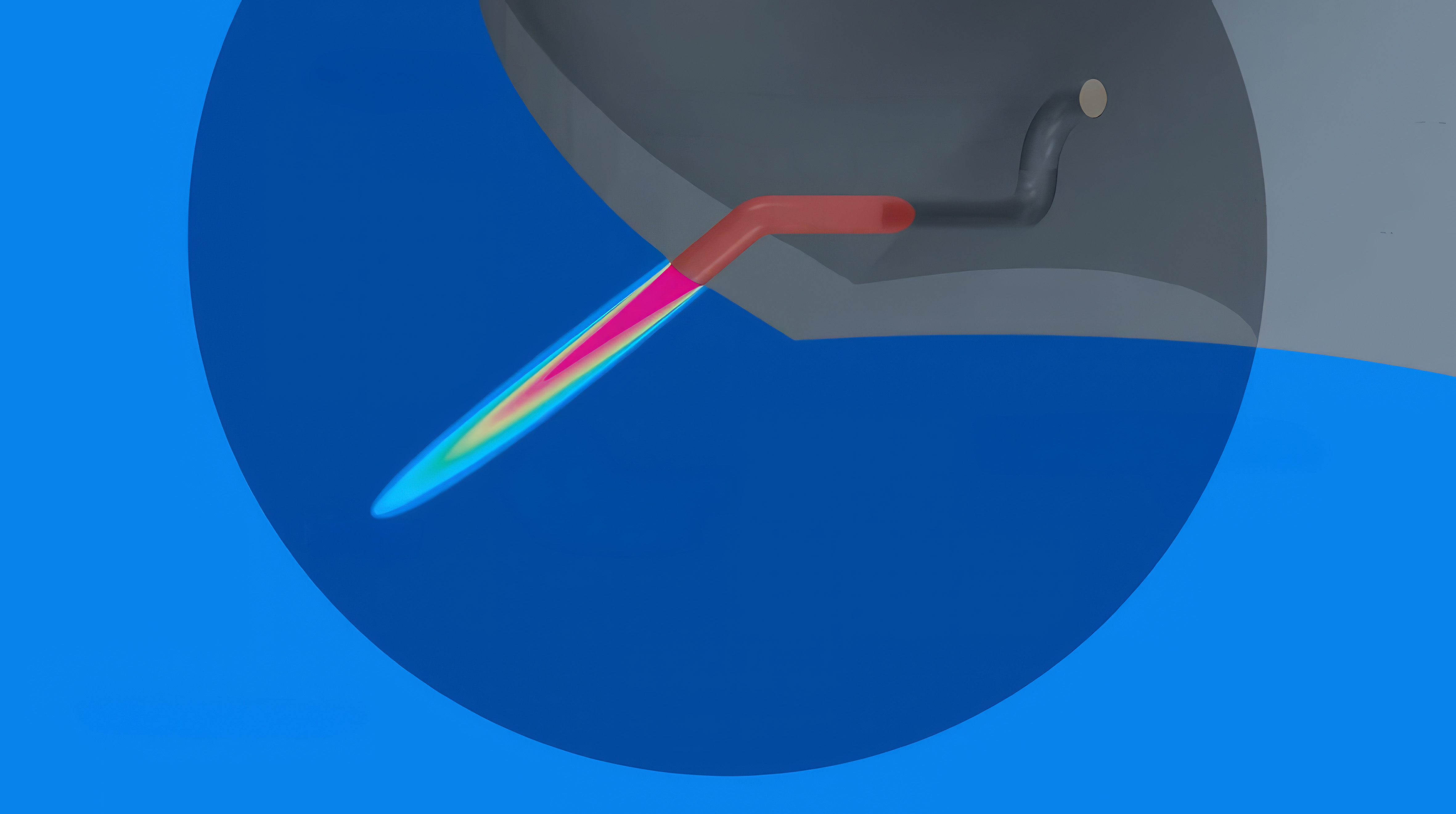
The work combines CFD-based fluid mechanics and chemical modelling to simulate washwater discharge behaviour for the specific vessel design and operating condition. The output documents pH distribution and dilution conditions around the overboard discharge point.
Maritime and offshore engineering
Marine scrubber discharge pH simulation for MEPC.259(68)
Document scrubber washwater discharge conditions with CFD-based pH simulations.
Shipping companies and scrubber suppliers may need documented evaluation of scrubber washwater for classification society review, particularly for new installations or modified discharge arrangements.
Vessel-specific discharge conditions
CFD-based fluid mechanics and chemical modelling simulate scrubber washwater discharge for the specific vessel configuration and operating condition. The documentation supports evaluation against the MEPC.259(68) requirement of minimum pH 6.5 at 4 m from the discharge point. The service is part of our expertise area Maritime and offshore engineering.
Challenges
When local pH conditions around the scrubber discharge are undocumented, compliance with the MEPC requirement becomes more difficult.
Vessel geometry affects discharge conditions
Differences in hull geometry, discharge arrangement and operating conditions influence how scrubber washwater disperses around the vessel. Without a vessel-specific simulation, the local pH distribution can remain uncertain.
Limited visibility of local pH distribution
Measured bulk values do not necessarily show how pH develops near the discharge point. Missing documentation of local dilution conditions can complicate technical evaluation work.
Difficult discharge cases may require optimisation
Some discharge configurations can make it difficult to demonstrate the required pH condition at 4 m from the overboard discharge point.
Benefits
Provide documented pH simulations supporting the evaluation of scrubber discharge
Visualise local pH conditions around discharge points
Simulation results illustrate how scrubber washwater disperses and dilutes around the vessel under defined operating conditions. The visual documentation supports the technical review of local pH conditions relative to the MEPC.259(68) requirement.
Support vessel-specific discharge documentation
The modelling work is adapted to the individual vessel configuration, discharge arrangement and operating condition. This provides a documented basis for technical review of the specific discharge scenario.
Evaluate insert designs for difficult discharge cases
Additional simulation work can compare insert designs in relation to mixing efficiency and pressure drop for discharge configurations where compliance is difficult to document.
