Authorities must use the EU’s common noise calculation method, CNOSSOS, for strategic road noise mapping. How do the results differ from previous calculations, and what data does CNOSSOS require?
The Danish Environmental Protection Agency initiated a project to help the relevant authorities understand and obtain the input data required for CNOSSOS calculations.
CNOSSOS is a simpler and less accurate method
CNOSSOS (CNOSSOS-EU) is a noise calculation method developed within the EU. Authorities must use it for the strategic noise mapping carried out every five years. From 2021/2022, CNOSSOS must be used for these calculations throughout the EU, pursuant to the Danish Noise Order (Executive Order no. 2092 of 18 November 2021), which implements the EU Environmental Noise Directive and describes the CNOSSOS method.
CNOSSOS is only to be used for strategic noise mapping within the EU framework. In Denmark, authorities must continue to use the Nord2000 method for calculations relating to environmental cases.
In many respects, CNOSSOS is considerably simpler and less accurate than Nord2000, although it is more detailed in a few areas. The transition to CNOSSOS requires source data, or input data, in a different format than previously, and the method will, to some extent, produce different results from those obtained using the familiar Nord2000 method.
In addition to describing the source and propagation method, the Danish Noise Order also includes a new method for counting noise-exposed homes and people. As a completely new requirement, estimates must also be prepared of the number of people at risk of developing serious noise-related diseases. This is not discussed further here.
Vehicle categories in CNOSSOS
Broadly speaking, CNOSSOS divides traffic into the same vehicle categories as Nord2000. However, in the original source catalogue supplied with the CNOSSOS method, there were relatively large differences in vehicle noise compared with Nord2000.
CNOSSOS produces lower values than Nord2000
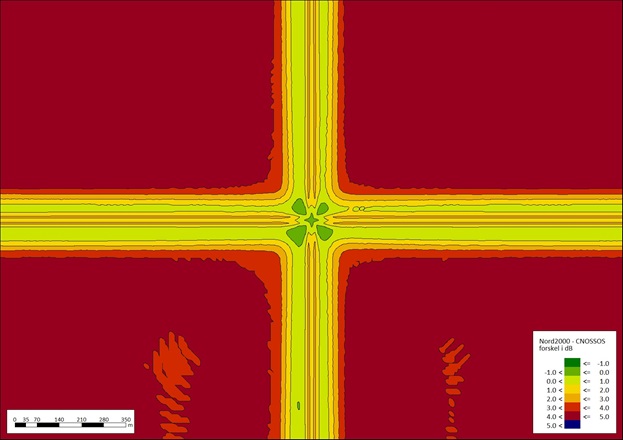
Force Technology converted Nord2000 source data for use with the CNOSSOS method on behalf of the Danish Road Directorate. Comparative calculations, as shown in Figure 1, for flat terrain without screening from noise barriers, embankments, buildings, or hilly terrain reveal several differences between the values produced by the two calculation methods.
The difference is smallest at short distances from the road, at 25 metres, and for the higher calculation position, at 4 metres. Further away from the road, the difference becomes greater, reaching up to 5 dB. CNOSSOS therefore generally produces lower values than Nord2000.
The differences are smallest at a calculation height of 4 metres. This is consistent with CNOSSOS having been developed for calculations at a height of 4 metres in urban areas, whereas in Denmark calculations are typically carried out at a height of 1.5 metres to determine noise exposure at a home or other building.
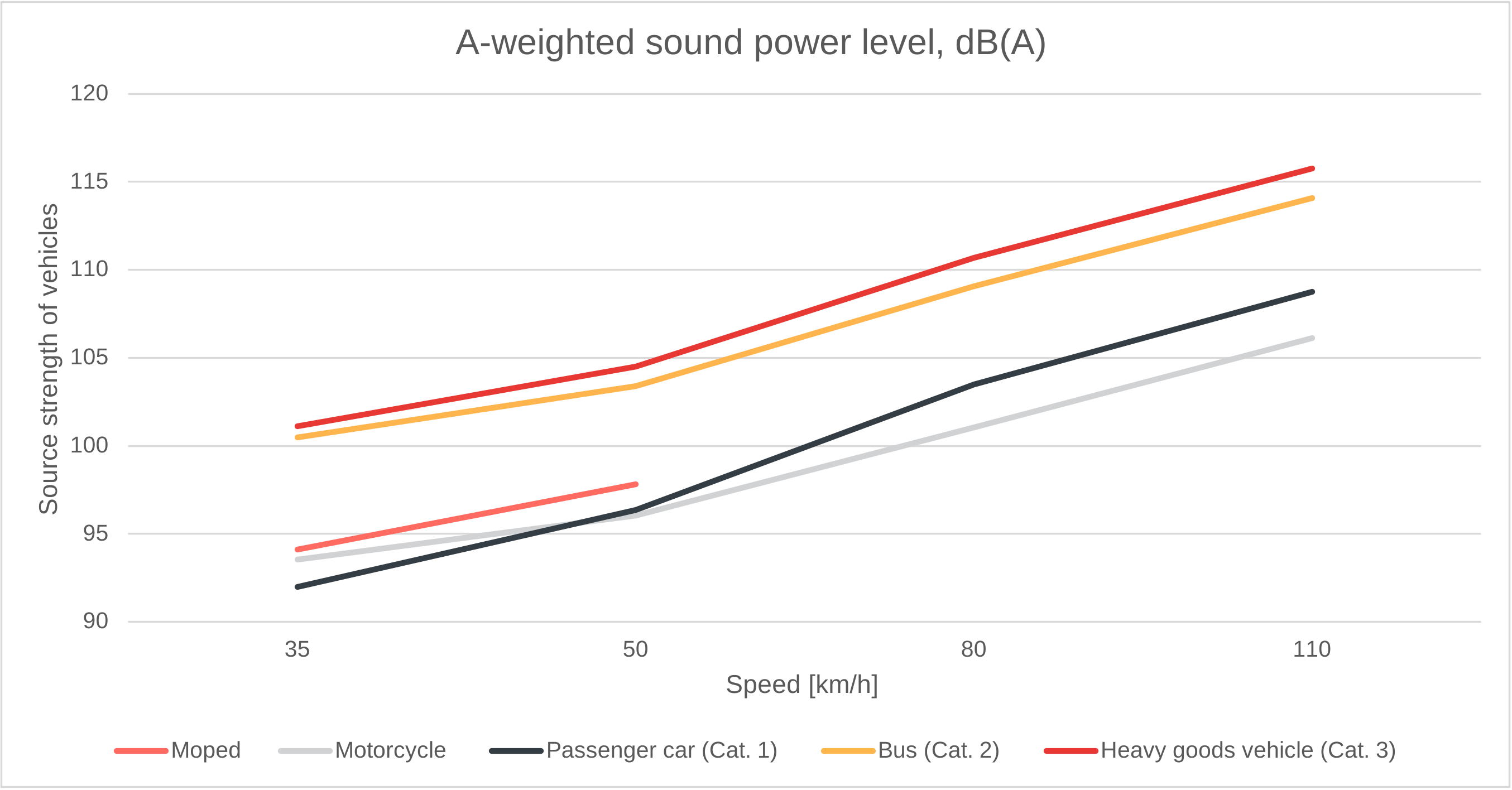
The corrections for different asphalt types familiar from Nord2000 can also be converted directly for use with the CNOSSOS method.
Motorcycles and mopeds can generally be excluded from noise mapping
As a new requirement in Denmark, both motorcycles and mopeds must be included in noise mapping if they have a material effect on the overall noise situation. In a city such as Rome, it probably makes sense to include mopeds and scooters, but what about Denmark? Traffic specialists from the Danish Road Directorate assisted with the assessment of this issue.
We first examined the number of registered motorcycles and 45 km/h mopeds in relation to passenger cars, as shown in Table 1.
Category | Number registered |
Motorcycles | 160,000 (6 %) |
45 km/h mopeds | 32,000 (1 %) |
30 km/h mopeds | 210,000* (8 %) |
Passenger cars | 2,600,000 |
Number of registered vehicles by category. Percentages in brackets are relative to the number of passenger cars.
Source: Danish Road Directorate. *Source: Estimate based on online source (Wikipedia).