By Alan Friis
When designing production piping systems for the food and pharmaceutical industries, dead legs are a recurring topic of discussion: How can they be avoided, and which criteria should be applied to their depth to ensure hygienic design?
The answer is: it depends on which reference is relevant to the specific case. However, it is generally accepted that hygienically designed systems must limit the depth of dead legs, as this has a direct impact on cleaning time. Longer dead legs require more time to clean and more time to reach the required temperature during sterilization with steam or hot water.
All criteria are based on the ratio between the pipe diameter (D) and the depth of the dead leg (L), where L is usually measured from the pipe wall. In general, the acceptable depth is specified as a depth-to-diameter ratio expressed as L ≤ xˑ∙D. The value of x depends on the reference, and they specify rather different requirements as criteria of 1D, 1.5D, 2D, 3D or 6D exist. So, which one is the right choice?
Europe and the food industry, including EHEDG
The European criteria for dead legs are the most stringent. The harmonized standard EN 1672-2 states that dead legs should preferably be avoided and, if they cannot be avoided, must be as short as possible. Figure 1 shows a dead leg shorter than the pipe diameter, which may generally be acceptable. For comparison, Figure 2 shows a dead leg that poses a hygienic risk because it is significantly deeper than the pipe diameter.
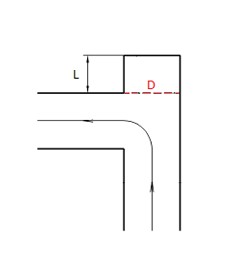
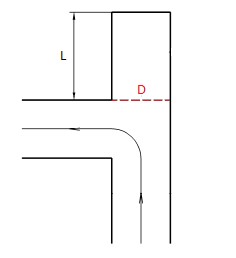
The European Hygienic Engineering and Design Group (EHEDG) specifies that the depth of a dead leg must be less than or equal to the pipe diameter, commonly referred to as the 1D rule. This criterion can also be considered appropriate according to EN 1672-2:2020.
The US, biotech and pharma industries, including FDA, 3-A, ASME-BPE, ISPE and WHO
In the FDA’s 1993 Guide to Inspections of High Purity Water Systems, a 6D rule is described. This is the only criterion in which the length of the dead leg is measured from the pipe centerline. The document is still used by FDA inspectors as guidance during GMP inspections. However, the pharmaceutical industry standard is generally considered to be the 3D rule, which is also supported by ISPE in its guidelines for water production systems for pharmaceutical use.
3-A Sanitary Standards Inc. and ASME BPE-2026 describe a slightly stricter criterion in the form of a 2D rule. In some cases, the biotech industry applies a 1.5D rule, although this criterion is not formally documented in standards or guidelines.
Where do the rules come from?
Before applying the rules, it is useful to understand their background and consider which application most closely resembles the specific case. The reason is that the rules originate from different industries:
- The 3D and 6D rules were originally developed for sterilized water systems used in pharmaceutical production.
- The 2D and 1.5D rules originate from the biotech and pharmaceutical industries and focus on equipment that must be both cleanable and sterilizable. 3-A applies the 2D rule to the certification of general sanitary equipment, including equipment used in food production.
- The 1D rule is directly relevant to the hygienic design of process equipment for food production, and EHEDG applies this criterion when certifying processing equipment. The European harmonized standard EN 1672-2:2020 was developed specifically for food applications and specifies that dead legs should be even shorter.
How should rules on dead legs be applied in practice?
There is no doubt that the best hygienic design is achieved by avoiding dead legs altogether, but this is not always possible. In practice, the following rules of thumb can be applied:
- In systems used to produce food, ingredients or similar products, where cleaning is performed by Cleaning in Place (CIP) and followed by disinfection with common disinfectants, dead legs should comply with the EHEDG criterion of L ≤ D.
- In systems used to produce biological products, where steam or hot water is used to achieve a defined level of sterilization of the production plant, the biotech industry criterion of L < 1.5D or the criterion of L ≤ 2D, as specified by 3-A and ASME BPE-2019, may be applied based on the relevant risk assessment.
- Longer dead legs should only be used in systems where the medium is very clean and preferably sterile. This may include water systems such as those described by ISPE, where steam is also used for sterilization. In such cases, the criterion of L ≤ 3D may be applied.
It is not recommended to exceed these criteria for the specific applications described above. For all the criteria mentioned, the depth of the dead leg (L) is measured in the same way: from the pipe wall. Dead legs greater than 3D should be applied with the utmost care and cannot be considered part of a hygienic or sanitary design. However, this does not exclude their use in particularly favourable situations, provided this is justified by an appropriate risk assessment.
Is it really a dead leg, or is it a cleanable branch?
In practice, designs must be assessed to determine which criterion is suitable for each application. A branch in a processing plant may only be temporarily shut off and may therefore not function as a true dead leg. The criteria presented above apply to static dead legs, whereas temporary stagnant zones in a processing plant may not compromise food safety if the plant is operated correctly. ASME BPE-2026 applies a risk-based approach, defining a branch as a dead leg only if it cannot be sanitized using the normal cleaning or steam sterilization procedure.
Background for the criteria based on flow mechanics
Figures 3, 4 and 5 show how a recirculation zone can form in a branch of a pipe. This occurs both in an upward-facing dead leg, as shown in Figure 5, and in an upward-facing dead leg where the flow is directed into the dead leg, as shown in Figures 3 and 4. If the dead leg is sufficiently short, the recirculation zone does not remain entirely within the dead leg (see Figure 3). The mean flow rate in the recirculation zone is usually significantly lower than the mean flow rate in the main pipe, and local velocities may be even lower. If the dead leg becomes very deep, potentially even at a depth of 3D, a second recirculation zone may form, with the mean velocity again decreasing significantly. This phenomenon and the typical mean flow rates are illustrated for an upward-facing dead leg in Figure 5.
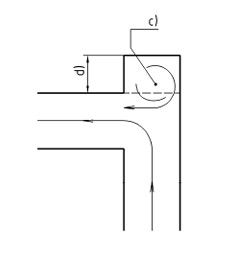
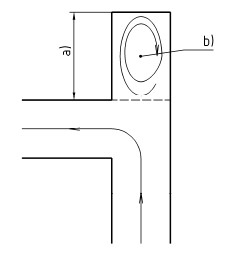
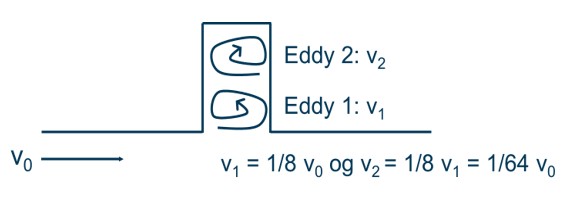
In practice, movement at the bottom of a dead leg with two recirculation zones is very limited, which reduces cleaning effectiveness and restricts liquid exchange. Liquid exchange is necessary to bring fresh detergent into contact with the surface. In general, liquid exchange is significantly improved when a sensor or similar component extends into the dead leg. This principle is also reflected in EN 1672-2:2020.
Conclusion
Dead legs should be avoided wherever possible in hygienically designed processing plants. When their inclusion is unavoidable, they should be kept as short as practicable. The criteria for what constitute an acceptable hygienic design vary depending on the specific process, industry, application, and, in many cases, regional regulatory requirements.
The following recommendations for dead-leg design are listed in order of priority:
- Dead legs with flow directed towards the dead leg, as illustrated in Figure 3, provide the most favorable conditions for liquid exchange. The incoming flow promotes flushing of the dead leg and reduces the likelihood of product stagnation. Hygienic performance can often be further improved through simple design enhancements, such as installing a temperature sensor within the dead leg.
- Upward-facing dead legs should always be kept as short as possible and should preferably only be used when required for instrument installation, such as a sensor. In general, the presence of a sensor within the dead leg enhances liquid exchange and reduces the risk of stagnant zones.
- Dead legs with flow directed away from the dead leg are not recommended under any circumstances, as they create the highest risk of product retention and inadequate cleaning.
These recommendations provide guidance for the design and assessment of dead legs in processes used to manufacture products where consumer safety is critical. However, a thorough risk assessment remains essential for every application. The guidance presented here should be regarded as a minimum requirement. For products with challenging rheological properties, such as high-viscosity fluids, the strictest dead-leg design criteria should be applied. In such cases, the preferred approach is to eliminate dead legs entirely whenever feasible.
Acknowledgements
We would like to thank Bo Boye Busk Jensen, Alfa Laval Cleaning and Mixing, for his valuable comments and suggestions.