
By Annette Baltzer Larsen
It is generally known that production lines must be clean and cleaning processes optimised. But 'clean' as compared to what, and most importantly, how do you best measure this?
There are differences in optimised cleaning processes
It can be challenging to determine how best to validate the cleaning of your production equipment—that is, to check whether the cleaning has been optimised. How do you ensure that potential shortcomings are detected in time?
There is also the question of whether the chosen cleaning procedure can be adapted to the specific cleaning process desired, as well as whether the cleaning validation is organised in such a way that the most hygienically critical areas are examined.
An optimised cleaning process for one production unit is not necessarily optimal for another. When considering the four parameters important in the cleaning process, it is essential that they all fill the 'pie chart' (see Figure 1), which indicates an optimised cleaning result where all biofilm formed during production has been removed.
The Sinner’s Circle ensures an optimised cleaning procedure
Optimised cleaning should, figuratively speaking, fill a pie: the so-called Sinner’s Circle (see Figure 1). The cleaning process used should be optimised to fit the specific production, such as production type, duration, type of organic material soiling the surfaces, and the hygienic design of the production equipment.
As shown in Figure 1, the four parameters involved in the cleaning process are:
- The cleaning agent, which should be chosen according to the type of soiling (organic matter) present on/in the production equipment.
- The cleaning temperature, which should be adjusted to the temperature at which the cleaning agent works best, but also to the organic material to be removed.
- The cleaning time, which should be long enough to remove the biofilm built up during production time.
- Mechanical action is the most difficult parameter to optimise throughout the production equipment. Cracks, crevices, and sharp angles may be hard to access in open systems and difficult to achieve good flow in closed systems.
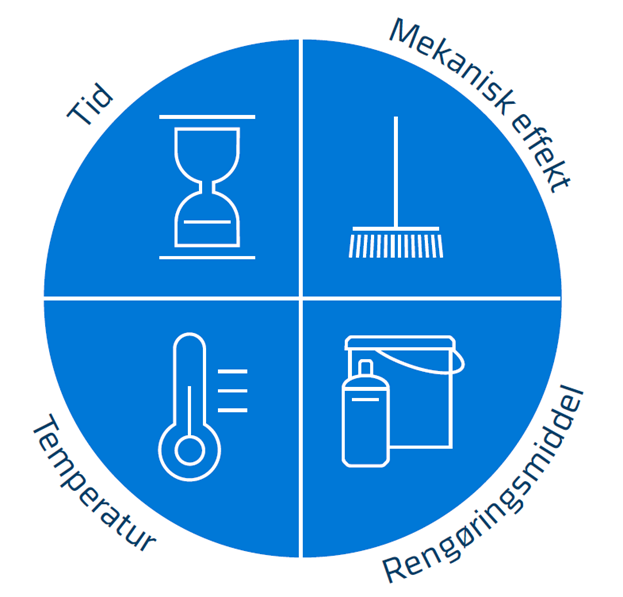
Let’s take, for example, a pan from last night's Bolognese: soaking in cold water is not very effective. Nor is adding a little dish soap to the cold water. However, using hot water with soap improves cleaning somewhat, but it only becomes really effective when mechanical action from a scrubbing brush is also applied. In other words, all four parameters in the Sinner's Circle must be used.
The distribution of the four parameters in the 'pie' will vary depending on the cleaning procedure chosen.
Regardless of the cleaning procedure, the equipment used must also be constructed according to hygienic principles. That is, CIP and COP systems must be hygienically designed with internal cleaning systems to keep themselves clean. The cleaning solution must reach all surfaces to be cleaned, and temperature and cleaning agent concentration must be maintained at set-points (that is, the temperature and concentration in the return flow).
For manual cleaning, brushes, scrapers, foamers/low-pressure systems, and so on, must also be kept clean.
All of this is crucial to prevent cross-contamination, also known as carryover of microorganisms or allergens from one production cycle to the cleaning fluid/equipment and then back to the production equipment.
Risk-based approach to the cleaning process
Regardless of which cleaning procedure is chosen for the specific cleaning process, it is important to take a risk-based approach to cleaning.
The cleaning fluid must reach all areas of the equipment to keep it clean. With a risk-based approach, the equipment should therefore be inspected, ideally both during production and during cleaning. It is key to identify hygienically critical hotspots so that extra attention can be paid to these spots during cleaning and so that they are included in cleaning validation. These critical hotspots are often places where product accumulates during production and where thorough cleaning is particularly challenging.
Common cleaning procedures in the food industry
According to 3-A Sanitary Standards Inc., cleaning procedures within the food and pharma industries are typically divided into four main types, some well known, others only used in parts of the industry.
Check whether your cleaning process is optimised
Is your cleaning effective enough for your specific production? Always assess whether your cleaning meets production requirements and consider how you can improve your cleaning validation.
