
See our wide range of courses
Find courses in NDT, welding inspection, corrosion, energy and environment, maritime, food safety, food contact materials, radiation safety, and more.
Find courses in NDT, welding inspection, corrosion, energy and environment, maritime, food safety, food contact materials, radiation safety, and more.
Force Academy, the Norwegian training division of Force Technology, adopted blended learning as part of the digitalisation process that began several years ago. To achieve the desired effect of the method, a number of frameworks and guidelines were established for its implementation. This is not a static process, but a dynamic process that is continuously evolving and adapting based on experience, new knowledge within the field, and feedback from course participants and course purchasers regarding their experience and learning outcomes.
In this article, I would like to elaborate on some of the considerations behind the choices and priorities made at Force Academy. It is beneficial for course participants, course purchasers and Force Academy to share a common understanding of the method and the frameworks we, as an academy, have established. This will make it possible to take even greater advantage of the opportunities available and thereby improve learning outcomes, competence, and ultimately the status of the profession.
The blended learning method includes elements that differ from traditional classroom teaching and therefore requires course participants to change their approach to learning and the way they have traditionally acquired knowledge. I will return to this later. To begin with, let us look at what blended learning is.
The short answer is that blended learning is an approach to education that combines online teaching materials and opportunities for online interaction with traditional, location-based teaching methods.
Blended learning generally consists of a combination of traditional classroom teaching, online materials, and video-based instruction, as well as structured self-study where course participants work from materials made available online. By combining and blending these learning environments, the aim is to utilise the positive effects and opportunities available across the different platforms. This is done to support increased learning within the framework available.
In recent years, a number of teachers, researchers, and theorists have gathered information about how children and young people learn. Their studies have concluded that learning mainly consists of 3 key components: acquisition, transfer, and retrieval. The most effective way to learn is to organise learning into short sessions with frequent breaks and repetition. Research within educational psychology has shown that learning distributed in smaller intervals over a longer period is more effective than intensive learning over a shorter period (Baddeley 1990). A learning session should therefore be organised according to the 4 steps Preparation, Work, Follow-up, and Repetition.
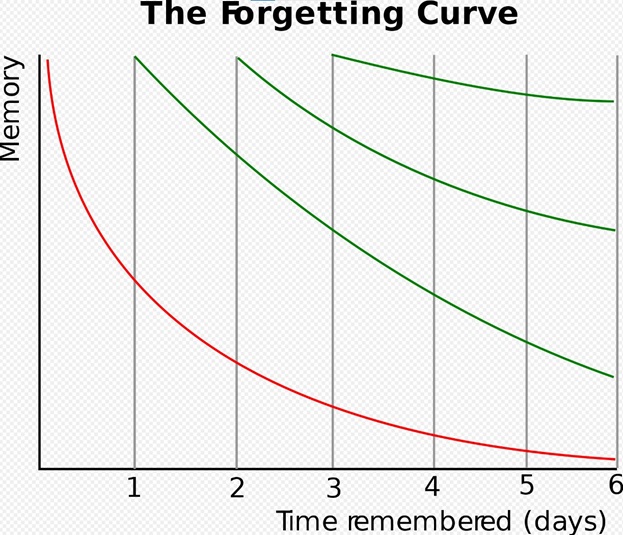
The importance of regular repetition to avoid forgetting knowledge was also highlighted by psychologist Hermann Ebbinghaus in his experimental studies of memory at the end of the 19th century. This is clearly illustrated by “the forgetting curve”, which summarises Ebbinghaus’ studies.
https://en.wikipedia.org/wiki/Forgetting_curve
Force Academy has found that blended learning can better support improved learning outcomes through increased opportunities for variation and access to course materials. At the same time, blended learning provides greater flexibility and opportunities for individual adaptation. Through the frameworks established for teaching and the way different tools are prioritised, it is possible to utilise different effects and tailor teaching to participants’ needs. Overall, there are 6 main models of blended learning (Tobin 2022). These models combine and prioritise learning modalities differently. The illustration below provides an overview of learning modalities.
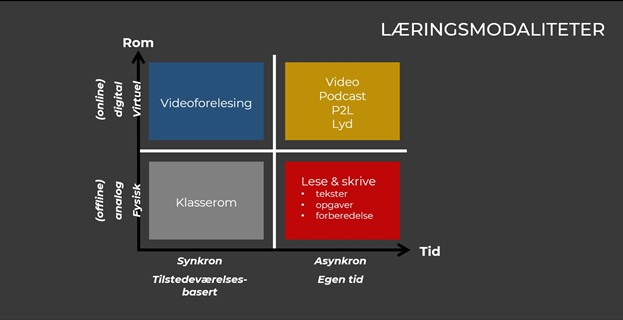
Today, Force Academy primarily uses the model known as “flipped learning”. This means that teaching is largely instructor-led, although this approach provides greater flexibility and opportunities for individual adaptation than traditional teaching. In this model, we use elements from all learning modalities and consciously vary their use. Which modalities are emphasised most varies from course to course and depends on the framework established by standards, as well as what we believe provides the best learning outcomes in relation to the knowledge and skills participants are expected to have after the course.

Blended learning offers several advantages. Some of the benefits that Force Academy sees, and the reason we use this method, include the ability to:
One advantage of blended learning is that digital materials can support teaching. This makes it possible to improve the learning experience through variation in how content is presented and through the methods and tools used. Digital course materials also allow individuals to work at their own pace and repeat videos several times without affecting the time available to other participants. This makes it easier for course participants to focus on and immerse themselves in areas where they need to close knowledge gaps. In addition, e-learning allows learners to choose where and when they want to acquire knowledge.
Because course materials are available before the course begins, participants have the opportunity to prepare well in advance. This allows them to watch videos multiple times and complete exercises, enabling them to gain greater value from the digital sessions on Teams during the course.
By arriving well prepared, participants have a stronger foundation for actively participating in professional discussions and discussing relevant issues. As previously described, research also shows that people remember better through regular repetition over time than through intensive cramming.
However, the socialisation and interaction that occur through physical attendance are necessary to develop certain skills and can never be fully replaced by pure e-learning. It is therefore important to combine the modalities and teaching methods best suited to the subject matter and course objectives. For example, the acquisition of theoretical knowledge is well suited to e-learning, while interpretation, evaluation, and practical application are better suited to synchronous teaching. Through blended learning, it is therefore possible to benefit from the flexibility and individual adaptation offered by digital tools while reducing the negative effects associated with relying solely on e-learning.
The use of e-learning opens opportunities to use a wider range of learning tools and learning environments. This provides greater opportunities to vary approaches to the subject matter and create variation and increased concentration. At the same time, course participants gain greater freedom to choose and combine materials and resources and find the tools best suited to their preferred learning strategy.
Blended learning is a teaching method that encourages course participants to take greater responsibility for their own learning. This responsibility can also contribute to a greater understanding of the learning process and better insight into how individuals learn most effectively.
Blended learning places strong emphasis on interaction and collaboration. Online teaching is more effective when course participants collaborate rather than work individually. Online collaboration can take place in many ways, including synchronous communication such as chats or online meetings, or asynchronous communication such as discussion forums, online discussions, or group assignments with submissions. Online interaction is often perceived as relatively anonymous, which can make it easier for more reserved participants to engage actively.
Through increased digitalisation, blended learning reduces costs associated with travel and accommodation. At the same time, blended learning is considered a more environmentally friendly alternative because it reduces the environmental impact associated with travel activity and decreases the consumption of paper and printed course materials.
Most people in the Western world today have grown up with technology and digital tools. This has significantly changed the way we communicate and acquire knowledge. This is especially true for millennials and Generation Z (1995–2010), who communicate through social media on a daily basis. The use of blended learning as a teaching method is therefore likely to resonate better with these generations than traditional classroom teaching.
In the United States, enrolment in online courses has increased for 14 consecutive years, while the number of students participating exclusively in face-to-face university teaching has declined (Seaman, Allen & Seaman, 2018). In 2016, more than 6 million students in the United States enrolled in at least one online course (Lederman, 2018), and the proportion of students enrolled in at least one online course has risen to more than 30% (McGraw, 2021).
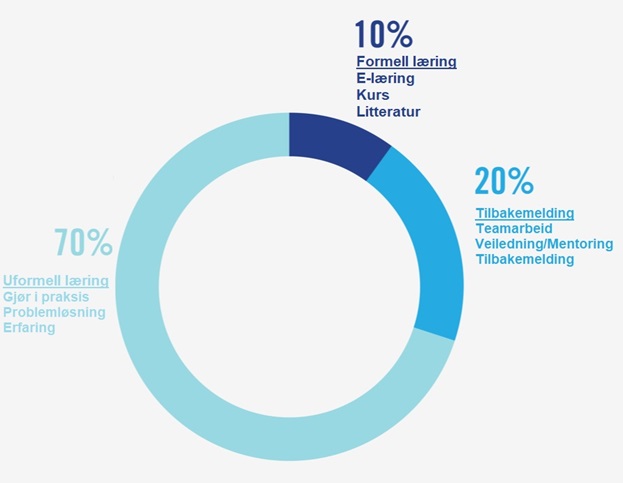
The 70-20-10 model is a framework that describes how we learn. The model is based on the idea that most learning does not occur during courses, but through informal experiences gained in daily work, as well as through relationships, networks, and the feedback we receive.
The model shows that the smallest proportion of learning comes from formal courses (Stander, 2022). Although it is only a model, it still provides insight into the areas organisations should focus on and prioritise to ensure effective learning.
Although the learning that takes place through formal courses only represents a smaller part of total learning, this does not mean it is insignificant. Courses are, and will continue to be, an important part of learning. They establish a proper foundation through a basic understanding of how the profession functions and how it should be practised within the framework established by standards and other requirements.
What the model does clarify, however, is that companies should be cautious about viewing a course as the only form of learning. Organisations should develop a plan for how informal learning should take place. This can include consciously selecting who works together, rotating work tasks and providing frequent feedback from managers regarding how tasks are carried out.
Learning through relationships highlights the importance of mentoring schemes and follow-up from managers or level 3 personnel in practical settings. Through individual follow-up, guidance, and role modelling, managers can contribute to important learning, workplace culture, and good professional practice.
The various opportunities for improved learning through blended learning have now been reviewed. Some of the benefits include increased access to and greater variation in learning materials, as well as opportunities for greater flexibility and repetition of knowledge.
At the same time, while blended learning creates more opportunities, it also places greater responsibility on the individual. Effort and engagement are required to improve learning outcomes and fully benefit from the opportunities available. This applies both in terms of taking greater responsibility for one’s own learning, needs, learning strategies, and expectations, and actively engaging in the teaching rather than using the increased flexibility as a reason to approach the course less seriously.
We have established a number of frameworks for course delivery, which I will briefly describe. At the same time, we would like to provide course participants and course purchasers with recommendations to help ensure the best possible learning outcomes, the best possible course experience, and the greatest possible value from the resources invested in education and training.
To help participants gain maximum benefit from a course, we recommend that they log into our learning platform – Plan2learn – well before the course begins, watch videos, complete exercises, and then regularly review the material leading up to the course start. We make course materials available as soon as participants enrol. We also recommend that managers provide professional support and guidance during this process by combining theory and subject matter with practical training and guidance in daily work.
Force Academy has developed a model designed to help and support companies in creating strong frameworks for learning and competence development. We want to help organisations view training as more than simply attending a course. By considering the entire training pathway within the desired field and establishing clear frameworks through planning both courses, internal training, and desired competence goals after completion, we believe organisations can achieve greater learning outcomes and better overall effect. This means, for example, using courses and training as the foundation for learning rather than viewing them as learning itself. In employee development plans, organisations should therefore define the framework for training. In addition to a course, organisations should make internal training and mentoring visible, planned, and prioritised within the educational pathway.
As an academy, we recommend that companies enrol employees in courses at an early stage, allowing participants to access training videos and course materials early in the educational process. This gives participants the opportunity to familiarise themselves with the subject matter and prepare properly, ensuring they have a professional foundation before the course begins. If the company also has an overall training plan in place, it can support the process with practical experience and internal guidance. This better equips employees to address and solve professional challenges correctly.

NDT Refresh is designed to further expand the concept of training within NDT. Through this product, we aim to make learning materials, e-learning, and other resources more accessible for continuous professional updating and competence development during the certification period.
The platform and the framework established around it are intended to create a foundation for recommended professional practice while also providing tools and resources that can simplify daily tasks and workflows for companies’ level 3 personnel. The purpose of NDT Refresh is therefore to provide the NDT industry with a toolbox and a foundation for professional maintenance and development throughout the certification period, while also enabling companies to reduce risk by monitoring performance and adapting training based on identified findings.
I believe that continuous professional updates combined with mentoring will help establish the right foundation for improved learning outcomes and higher levels of competence across professional disciplines. I also believe that this provides a better understanding of the future of learning and training than the traditional view of courses as the training itself.
Future challenges require flexible and effective tools. I believe that the opportunities provided by blended learning, combined with an internal training strategy, create a strong foundation for exactly that.
