What affects our experience of noise from road traffic?
How can road authorities reduce the noise annoyance experienced by residents without reducing the actual noise level? This has been investigated in the European FAMOS project – and the results are now available.
Background and purpose of the FAMOS project
Noise and noise mitigation are often significant challenges for road authorities when planning new roads or working on the maintenance and improvement of existing roads.
Authorities typically focus on reducing the actual noise. In doing so, they use solutions that are technically feasible in the given situation and within the available economic framework to achieve noise reduction.
Some of the measures typically used in Denmark to reduce road traffic noise are:
Low-noise asphalt
Noise barriers and embankments
Noise insulation of dwellings
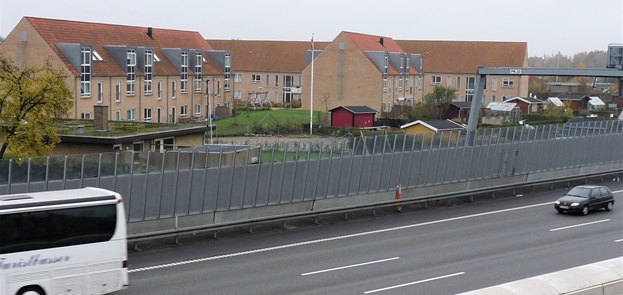
Even after such noise-reducing initiatives have been implemented, it may still be necessary to further reduce the perceived noise annoyance for neighbouring residents to regard the situation as significantly improved (see Figure 1).
This is where the results of the FAMOS project come into play (see Factbox 1). The purpose of FAMOS (FActors MOderating people's Subjective reactions to noise) is to analyse and test whether non-acoustic factors (moderators) can be used by road authorities as a tool to reduce noise annoyance without lowering the actual noise level.
Figur 1: På strækninger langs de eksisterende veje kan der være behov for at reducere den oplevede støjgene yderligere for at forbedre levevilkårene. Det kan fx gøres ved at anvende de moderatorer, som er udviklet i FAMOS-projektet.
FAMOS-PROJEKTET
The FAMOS project is funded by CEDR (Conference of European Directors of Roads), which is the collaborative organisation for European road authorities.
The FAMOS project was carried out during the period 2018 to 2022 by a consortium consisting of three partners:
FORCE Technology in Denmark, which acted as the project leader
SINTEF (Foundation for Industrial and Technical Research) in Norway
Perceived noise annoyance – actual noise level combined with moderating factors
The annoyance experienced by residents living along a road from traffic noise is a function of the actual noise level as well as some moderating factors:
The context in which the noise is experienced. This can be the physical surroundings, e.g., whether there is a quiet side to the dwelling, whether there is vegetation, and whether the road is visible.
The citizens’ relationships with and perception of the authorities, as well as their attitude toward the noise source (hereafter referred to as socio-social conditions).
Personal factors such as noise sensitivity and tolerance towards the noise source, etc.
The FAMOS project has investigated what the physical surroundings and socio-social factors mean for perceived noise annoyance. These are aspects that road authorities can change and influence in various ways.
In contrast, road authorities have no possibilities to influence people’s noise sensitivity and tolerance. Therefore, these have not been included in the project, even though they can have a significant impact on perceived noise annoyance.
Survey studies of perceived noise annoyance
Surveys of perceived noise annoyance are typically carried out using questionnaires. People are asked how annoyed they are by traffic noise in their homes. The results are presented as dose-response curves, where the x-axis shows the actual noise level calculated at the façade of the dwellings, and the y-axis represents the percentage of respondents who are highly annoyed by the noise.
Twenty years ago, the EU published a dose-response curve for noise from road traffic [1] (see the blue curve in Figure 2 below). It shows that at 58 dB, a little under 10% of residents are highly annoyed by road traffic noise.
This general EU curve is based on 26 different surveys, primarily conducted in Europe. In total, the surveys include more than 19,000 responses, meaning the curve represents an average of many different situations.
The Danish Road Directorate subsequently conducted some large surveys – in 2013 [3] and 2016 [4] with 9,631 responses along urban roads. The results show, among other things, a 'Danish' dose-response curve for urban roads, which is almost identical to the EU curve. Thus, it can be concluded that the EU curve is very 'robust', serving as a reliable general Danish correlation between annoyance and noise level.
Figure 2: The EU dose-response curve (blue) for noise from road traffic [1]. The two green curves indicate that special circumstances can alter the actual dose-response curve.
Looking more closely, there can be cases where the relationship between noise level and the proportion of highly annoyed is different from what the EU curve shows. For example, this can occur in situations where the physical surroundings or socio-social factors are special. In such cases, the dose-response curves will differ from the EU curve. They can, for example, lie within an interval indicated by the two green curves in Figure 2. Here, some moderators can affect perceived noise annoyance, without the actual noise level changing.
What is a moderator?
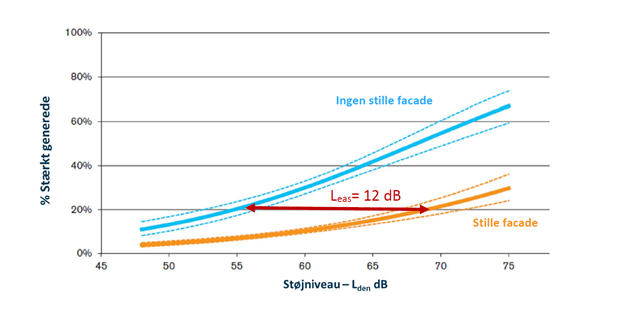
Figure 3 shows two dose-response curves. The blue curve shows a situation where residents do not have access to a quiet side. The orange curve represents a situation where there is access to a quiet side. When comparing the two curves, the proportion of highly annoyed residents at, for example, 68 dB is significantly reduced when there is a quiet side. Therefore, the presence of a quiet side can be described as a moderator.
In FAMOS, the effect of a moderator is determined as a change in the perception of noise level, for example with and without a quiet façade. Thus, a concept is introduced, defined as the annoyance-equivalent noise level change (Leas). Leas is the shift in noise level that will result in the same change in annoyance as the presence of a moderator [5]. In the example from Figure 3, Leas would be 12 dB.
Figure 3: The blue curve represents a situation where residents do not have access to a quiet façade (without moderator), and the orange curve a situation where there is access to a quiet façade (with moderator). Leas is defined in the text.
How were the 10 moderators identified?
In FAMOS, an international literature study was conducted to find studies of noise annoyance where it was possible to establish that a moderator was present, such as access to a quiet side. In total, more than 132 relevant studies were found [5], and the following could be concluded:
The degree of annoyance is influenced by a set of non-acoustic factors – moderators.
The size of the effect Leas varies.
Different studies find different sizes of effects.
The use and effect of these moderators depend on local conditions.
The findings were discussed with several key international experts, who generally supported the hypothesis regarding moderators.
To supplement and substantiate the effect of the identified moderators, a small survey was conducted in Hamburg as part of FAMOS [5]. Sound walks were also conducted in Copenhagen in situations with and without selected moderators [5]. In addition, a series of listening tests was conducted in FORCE Technology's laboratory, where subjects assessed noise experiences, also in situations with and without selected moderators [5]. Furthermore, a first statistical model was developed for how the presence of moderators affects dose-response curves and hence Leas [5], based on results from the Danish Road Directorate’s previous surveys [3 and 4]. In total, 6,316 responses were included in the model work.
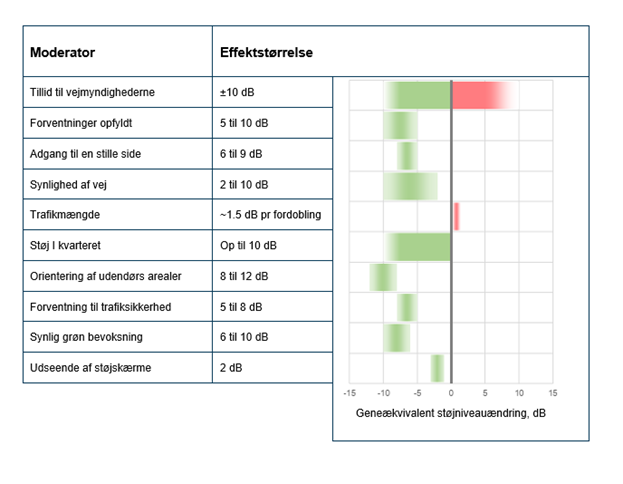
The analyses resulted in a list of 10 important moderators. Based on the literature review and the above studies, a first estimate could be made of the moderators’ annoyance-equivalent noise level change (Leas) [5]. The 10 moderators and their effect are shown in Figure 4. The moderators’ effect (Leas) typically ranges between 2 and 10 dB, which is quite significant.
Figure 4: The 10 moderators and their effect on perceived noise annoyance, expressed as the annoyance-equivalent noise level change (Leas).
Examples of moderators and their application
The following presents four moderators, and briefly reviews how they can be applied in practice:
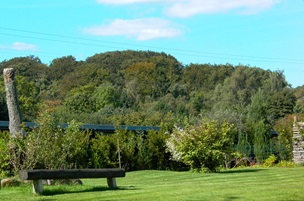
The visual appearance of an area and the presence of green vegetation have a reducing effect on perceived noise annoyance, with an effect expressed as Leas of 6 to 10 dB. This moderator can be used by establishing green vegetation with trees, bushes, etc.
If, for example, a motorway can be directly seen from a residential area, it has a negative impact on perceived noise annoyance. This effect can be changed by 'hiding' the road behind green vegetation, a fence, a solar panel, a noise barrier, a building, or similar. This can have an effect expressed as Leas of 6 to 10 dB.
Residents’ trust and acceptance of authorities and road owners are highly significant for perceived noise annoyance, with a range in Leas of up to 20 dB from great distrust to great trust. Road authorities can work with this moderator by organising a good, honest, and inclusive public process in connection with planning new roads and noise reduction measures.
In connection with establishing noise barriers, residents' expectations to the actual noise reduction are very important, corresponding to a Leas of 5-10 dB. If people expect that a new noise barrier "switches off" road noise entirely, they will be very disappointed, as the traffic will still be audible – albeit at a lower level. Road authorities can work with this moderator by:
providing good public information
involving residents and giving them influence over the design of a noise barrier
giving people 'ownership' of the noise barrier
organising realistic demonstrations of the barrier's noise effects.
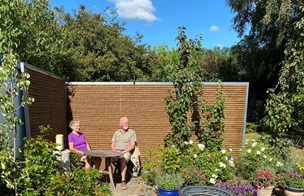
Figure 5: Establishing green vegetation can moderate perceived noise annoyance by 6 to 10 dB.Figure 6: Having access to a quiet side at the dwelling can moderate perceived noise annoyance by 5–10 dB. For example, a local noise barrier in a garden can create a quiet area at a home.
Handbook for road authorities on working with moderators
As the final part of the FAMOS project, a handbook was prepared on how road authorities can work with moderators. This may be in connection with planning new roads as well as the maintenance and improvement of existing roads. So far, the handbook is available in an English version 'Guidebook on how to reduce noise annoyance', which can be downloaded via FAMOS’s website [6].
The handbook is based on currently best knowledge, but it can be improved if new knowledge is obtained about moderators of perceived noise annoyance and their effect as expressed by Leas.
There is thus a need for more knowledge about the moderators and their effects. One way to obtain more knowledge is to conduct surveys when noise abatement is carried out along state and municipal roads. Sound walks on-site as well as listening tests in the laboratory may also be used in some cases.
It is important that road authorities try to collect more data on noise annoyance so that work with the moderators and the determination of their effect can continue. In this way, noise conditions for neighbours along our roads can be improved.
Documentation and references
1. European Commission: Position paper on dose-response relationships between transportation noise and annoyance, 2002 2. Noise from roads. Guidance from the Danish Environmental Protection Agency. No. 4 2007 3. Annoyance from urban roads and motorway M3. The Danish Road Directorate, Report 447 – 2013 4. Annoyance from urban roads and motorways. The Danish Road Directorate, Report 551 – 2016 5. FActors MOderating people's Subjective reactions to noise (FAMOS), Project Report. See: https://famos-study.eu 6. FActors MOderating people's Subjective reactions to noise (FAMOS), Guidebook on how to reduce noise annoyance. See: https://famos-study.eu

![Figur 2: EU´s dosis-responskurve (blå) for støj fra vejtrafik [1]. De to grønne kurver angiver, at specielle forhold kan ændre den faktiske dosis-responskurve.](https://img.eu.uniform.global/p/OgXBEJ79TAuG1WcAFjUNhw/uixBHlTASjS7US395IAeQA-figur-2-famos.png)