
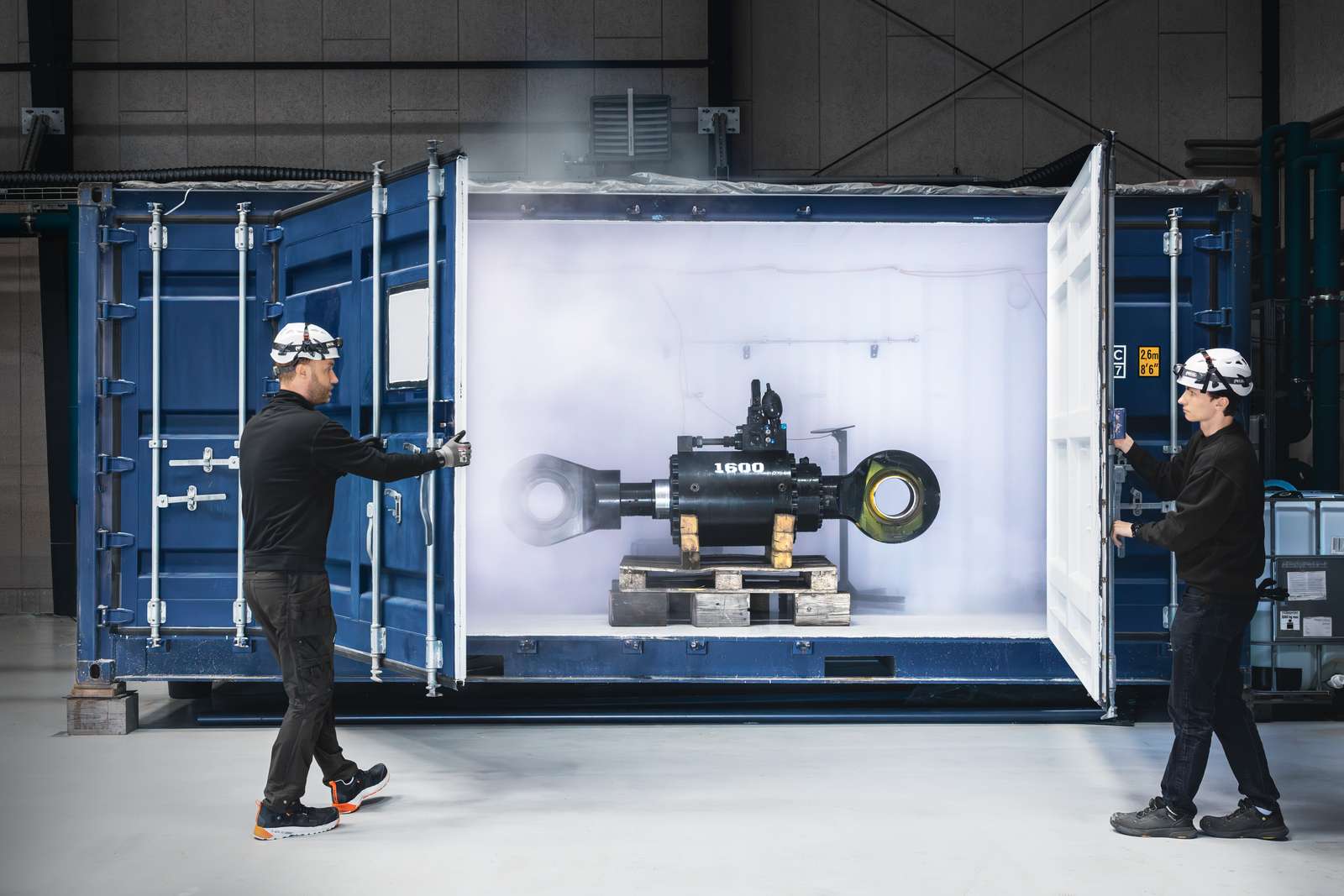
Force Technology carries out accelerated corrosion testing of large components, structures and complete systems in a dedicated test facility. We can test products that are too large for traditional salt spray chambers, particularly when the performance of the complete assembly is critical to the test results.
Climatic testing of large components and systems is also available at the same site.
Mechanical and environmental testing
Large-scale corrosion testing of fully assembled components and systems
Obtain documentation of how large and fully assembled products withstand corrosion under realistic and accelerated test conditions.
Corrosion testing of the complete assembly
Many companies test materials, coatings and individual components to assess corrosion resistance. However, corrosion problems often only arise once the product has been assembled and different materials, joints and fasteners interact.
Force Technology can carry out large-scale corrosion testing of fully assembled components and systems. This enables you to assess the effects of corrosion on the complete assembly rather than on individual parts. Testing is carried out in one of the largest commercial salt spray chambers in Northern Europe.
When the component is too large for traditional salt spray chambers
The service is relevant for products that are too large for traditional salt spray chambers or need to be tested in their operating configuration. This includes equipment for the offshore, wind, energy, transport and industrial sectors.
Documentation for development and validation
Large-scale corrosion testing can be used for design validation, product development, product qualification and the assessment of supplier solutions. The testing documents the product’s corrosion resistance and provides insight into potential risks before the product is installed or commissioned.
Challenges
Obtain documentation of how large and fully assembled products withstand corrosion under realistic and accelerated test conditions.
Large components cannot be tested in standard chambers
Many components, structures and technical systems cannot be tested in standardised salt spray chambers due to their size. This makes it difficult to document the corrosion resistance of the finished product under controlled conditions.
Corrosion testing of materials does not provide the full picture
Materials, coatings and individual components may perform well on their own, but the finished assembly may still develop corrosion problems. Combinations of different materials, joints, bolts and screws can create corrosion mechanisms that are not detected when individual parts are tested.
Corrosion problems are identified too late
If corrosion-related defects are only discovered after installation or commissioning, further investigations and modifications to the design or coating systems may be required. This increases both development time and costs.
Increasing requirements for corrosion resistance documentation
Especially in the offshore, wind and energy sectors, many companies face increasing requirements for corrosion resistance documentation. For fully assembled products, there is a growing need to document the performance of the assembly as a whole rather than only the individual materials.
Let’s clarify your corrosion testing needs
Do you need to investigate the corrosion resistance of large components, structures or complete systems? We can help define the testing requirements, test scope and relevant test programmes. This provides documentation of the product’s corrosion resistance under realistic test conditions. Please contact us to learn more.
FAQ
