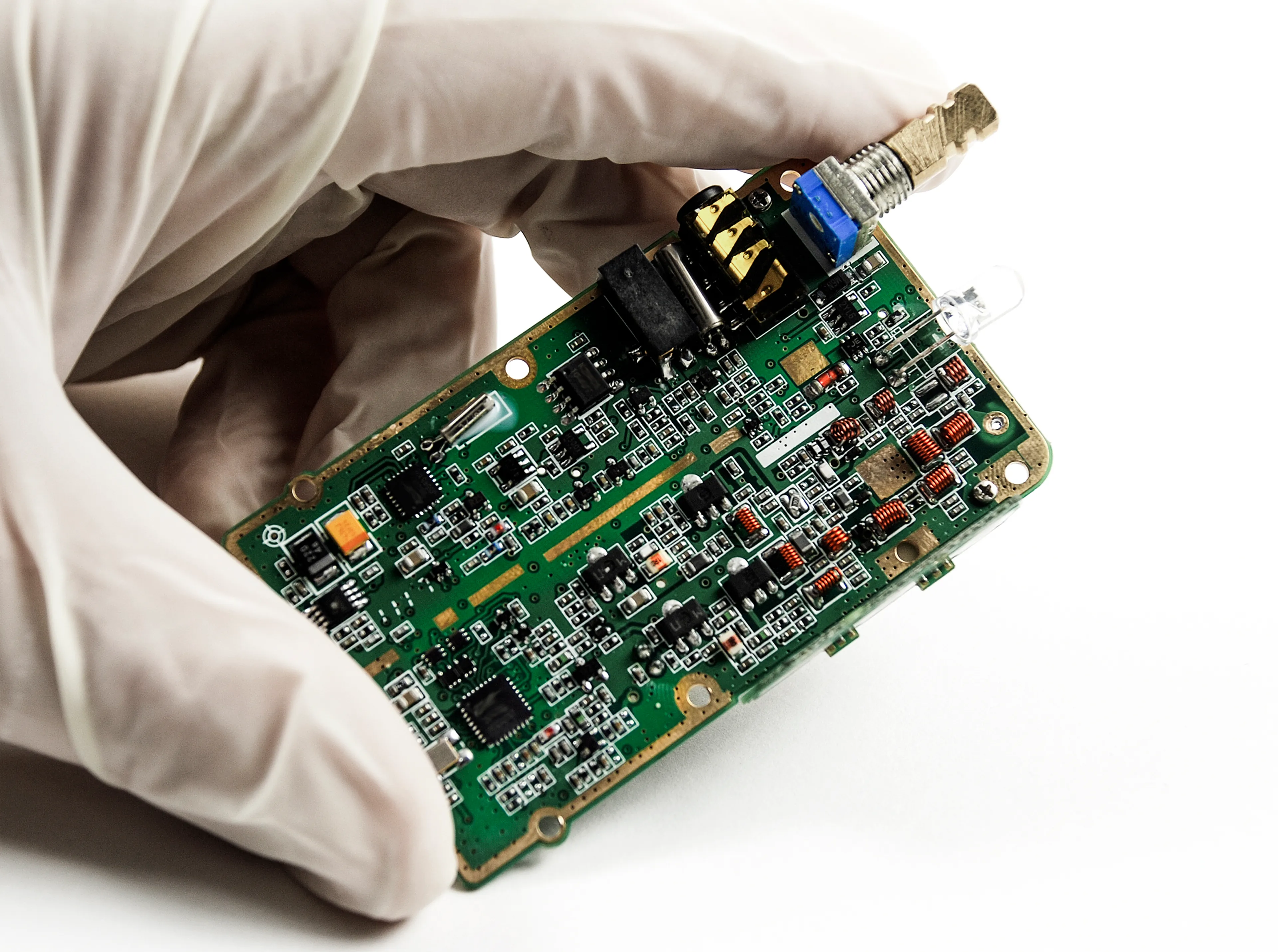
Knowledge of lifetime is important in product design, maintenance programmes, documentation of sustainability, and as basis for lifetime extension.
Calculating the lifetime of an electronic product requires more than a standard formula. It depends on understanding failure mechanisms, real operating conditions and how accelerated testing can be used to translate laboratory results into realistic lifetime estimates.
Why is calculating the lifetime difficult?
Calculating the lifetime of an electronic product sounds straightforward, but in practice it rarely is. There is no single formula that can tell how long a product will last in the field. Lifetime depends on how the product is used, the stress it is exposed to, and the ways its components gradually degrade over time.
Start with the way the product can fail
A realistic lifetime estimate begins with understanding how the product might fail. In electronics, failures are often caused by specific physical, thermal, mechanical or chemical processes. This is the basis of what is often called the Physics of Failure. The focus is on what drive ageing or wear-out.
Once the likely failure mechanisms are known, it becomes easier to decide what needs to be tested and which stressors matter most. Without that step, lifetime calculations can easily become too generic to be useful.
Define the conditions the product will experience
The next step is to describe the product's mission profile. This means mapping the conditions it will experience during its life cycle. Depending on the product, that may include temperature, temperature changes, vibration, humidity, electrical load, switching cycles or pressure.
This part is important because electronics do not age in isolation. They age in a specific environment and under a specific pattern of use. A lifetime estimate is only as good as the assumptions behind it. If the mission profile is unrealistic, the result will be too.
Use accelerated testing to create a realistic estimate
Once the relevant stressors are defined, accelerated lifetime testing can be used to estimate how long the product is likely to perform under normal conditions. In this type of test, the product is exposed to more severe or more frequent stress than it would normally experience in service, so that degradation happens faster in the lab.
The purpose is not simply to push the product until it breaks. The aim is to reproduce the same failure mechanisms that occur in real use, only faster and under controlled conditions. That is what makes the results useful for lifetime calculation.
Understand the difference between test types
Not all reliability tests are designed to calculate lifetime. A Design Verification Test is typically used to verify whether a product meets defined environmental requirements. A robustness test, such as HALT (Highly Accelerated Limit Testing), is used to quickly reveal weak points by applying very extreme stress.
The purpose of the accelerated lifetime test is to expose the product to relevant stresses in a way that allows real wear-out behaviour to be modelled and translated into expected lifetime in actual use.
Choose the right acceleration model
To convert test results into a lifetime estimate, an acceleration model is needed. This model describes how a given stress factor affects degradation over time. The relevant model depends on the underlying failure mechanism. Thermal ageing may be described with the Arrhenius equation, while mechanical wear may follow an inverse power law. Further, the generic lifetime model has to be adapted to the specific failure mechanism.
This is one of the most important parts of the process. A lifetime estimate may look convincing on paper, but if the chosen model does not match the real failure mechanism, the result will be useless.
Determine which parts of the product needs to be tested
A useful lifetime calculation is based on an evaluation of the complete product and the lifetime limiting components. A LED assembly is an example of a lifetime limiting component. The light source itself may degrade over time, but so does the power supply connected to it. Repeated switching, elevated temperature and fast temperature changes affect how the system ages.
By testing samples under different temperatures and operating cycles, and by measuring how light output changes over time, it becomes possible to estimate when performance drops below an acceptable threshold. That time to failure during test conditions can then be used to define the lifetime for a given use case.
Match the test to the dominant wear mechanism
Other products are driven by very different stresses. In a slip ring system, for example, lifetime is largely determined by mechanical wear. In that case, current and contact force may be the main stress factors. By testing different combinations, it is possible to see how each factor affects wear and how the combination changes the expected operating life.
Here, lifetime may be defined as the point at which wear reaches a minimum functional limit and the electrical connection becomes unstable. That kind of result can then be used directly in maintenance planning and service interval definition.
What a credible lifetime calculation looks like
A credible lifetime calculation combines four things:
- Understanding of failure mechanisms
- Realistic mission profile
- Accelerated testing with relevant stresses
- An acceleration model that reflects the underlying physics
When these elements work together, the result is a documented estimate of how the product is expected to perform over time in real operation.
That is also why lifetime calculation is not only a laboratory exercise. It is a way of turning product knowledge, test data and real operating conditions into a practical basis for reliability assessment, development decisions and maintenance planning.
