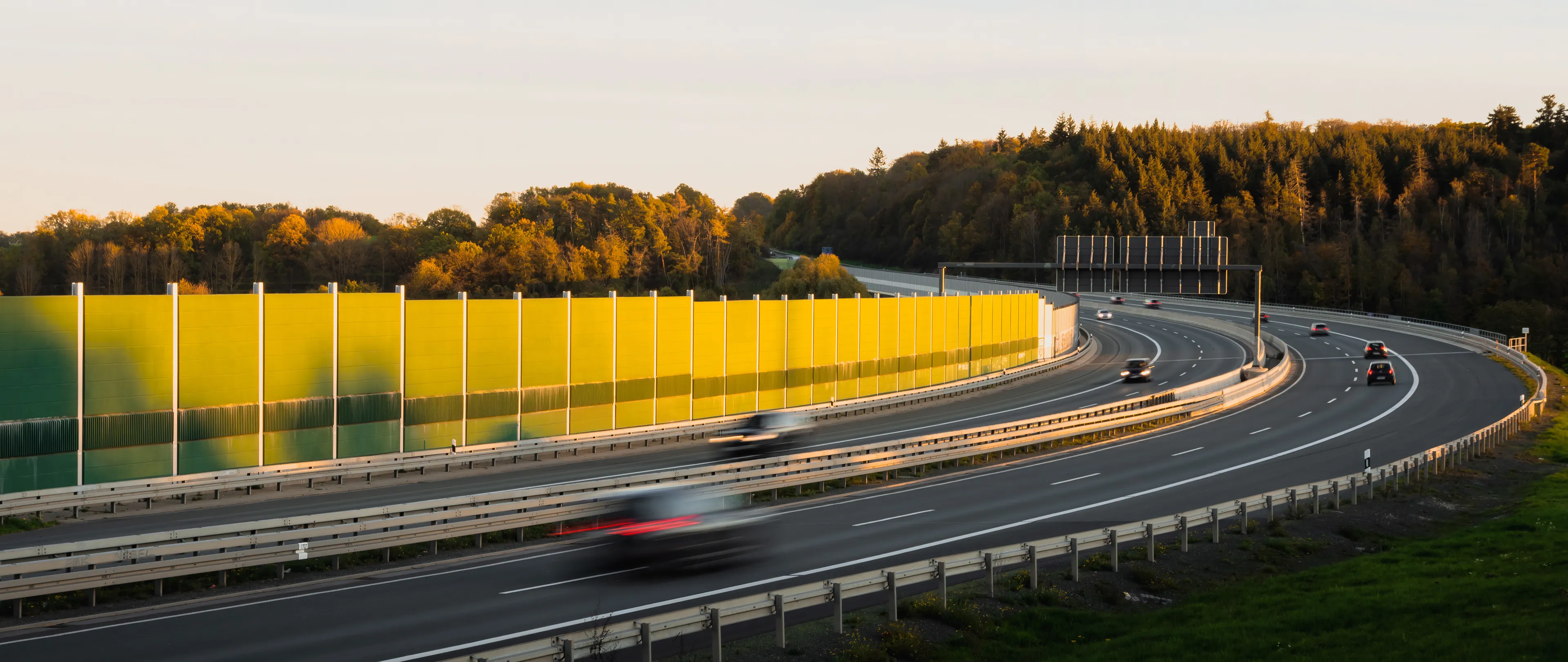
Nord2000 is the common Nordic method for calculating outdoor noise propagation from roads, railways, industrial facilities, airports and wind turbines.
The method was developed in the late 1990s and early 2000s through a joint Nordic collaboration involving leading acoustics institutes together with road and environmental authorities. The aim was to replace the simplified propagation models used at the time with a calculation method that better represents real-world conditions, including terrain, screening and meteorology.
Nord2000 is the standard method used for road traffic noise calculations in Denmark and has also been implemented in several other Nordic countries. Since its introduction, the method has been continuously refined and documented.
The method is widely recognised internationally for its ability to predict outdoor sound propagation under realistic environmental conditions.
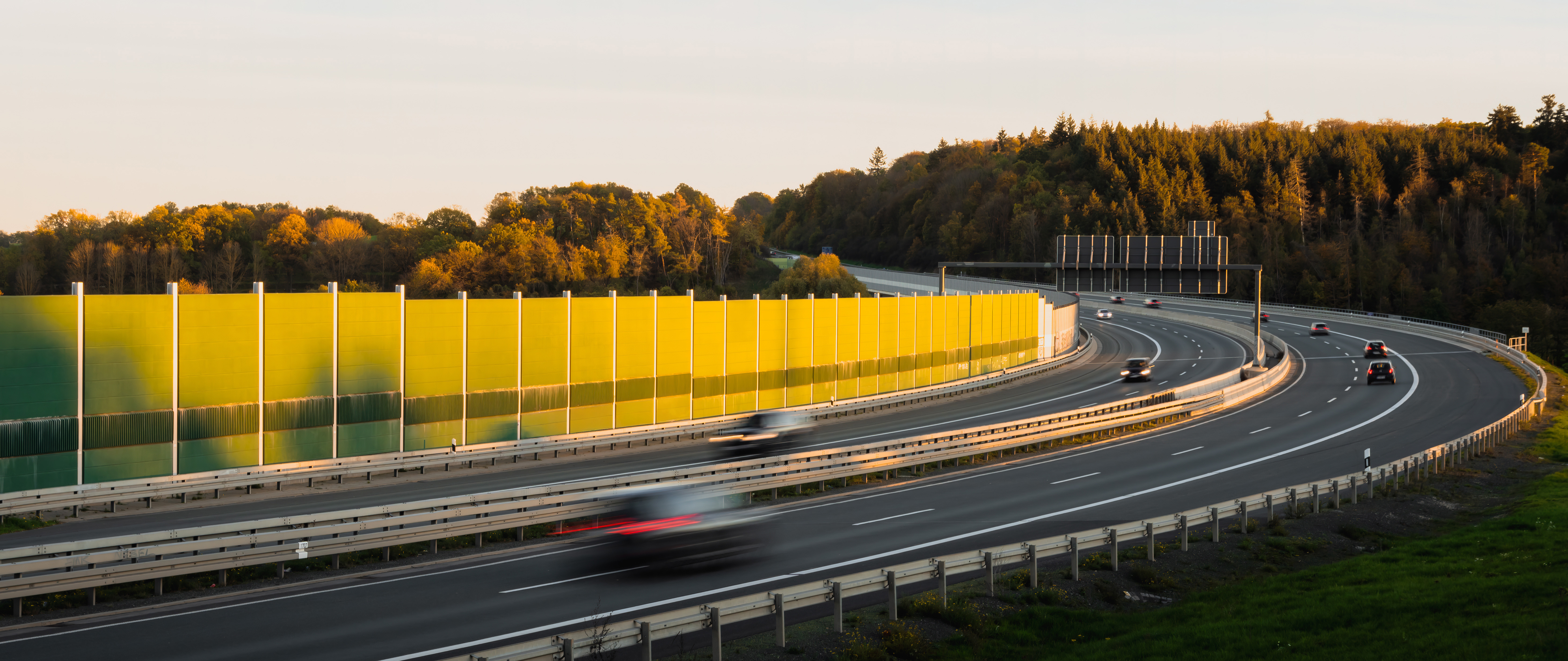
Calculates noise propagation under realistic conditions
Unlike earlier calculation methods, Nord2000 models the physical factors that influence sound propagation.
Calculations account for:
- Terrain geometry
- Ground surface characteristics
- Noise barriers and screening from buildings or terrain
- Meteorological conditions
- The distance between the noise source and the receiver
Terrain is represented using its actual geometry, while individual surface types can be defined as asphalt, grass or forest floor. Complex noise sources are divided into multiple point sources, allowing roads, railways and other linear sources to be modelled in detail.
This physical modelling approach makes Nord2000 suitable for calculations over both short and long distances, as well as in areas with complex terrain. It is therefore well-suited to noise mapping for municipal planning and infrastructure projects.
Meteorology is integrated into the calculation
Meteorological conditions are a fundamental part of the Nord2000 method. Wind direction, wind speed, temperature gradients and atmospheric stability all affect how sound propagates through the atmosphere and how effectively a noise barrier reduces noise.
Rather than relying on a single average weather scenario, Nord2000 uses a set of meteorological classes. Each class represents a specific combination of weather conditions and is weighted according to its frequency of occurrence. This enables calculation of long-term average noise indicators such as Lden (day-evening-night level) and Ln (night-time level), which are widely used in environmental assessments and national noise mapping.
The resulting values represent annual average noise exposure based on the range of weather conditions that typically occur.
Updated meteorological classes provide an up-to-date calculation basis
On behalf of the Danish Road Directorate, Force Technology assessed whether the meteorological classes used in Nord2000 between 1995 and 2004 continue to represent present-day weather conditions.
The study analysed ten years of meteorological data from several Danish Meteorological Institute (DMI) stations and compared nationwide datasets as well as differences between coastal and inland areas.
The results showed only minor differences between the previous and updated meteorological classes, typically below ±0.4 dB. The analysis also confirmed that regional meteorological classes are not required, as a single nationwide dataset continues to provide a representative basis for calculations across Denmark.
Although the resulting changes in calculated noise levels are small, the updated meteorological classes ensure that calculations are based on current weather data. This strengthens confidence in the method when it is used to support long-term infrastructure projects, environmental assessments and noise action plans.
A documented and validated method
Nord2000 has been validated through extensive comparisons with field measurements and numerical reference calculations. The propagation model has been tested across hundreds of calculation scenarios and is documented in international reports and peer-reviewed scientific publications.
Test cases and user guidance have also been developed to verify software implementations and help ensure consistent calculation results.
Applications of Nord2000
Nord2000 calculates outdoor noise propagation from road and railway traffic as well as from industrial facilities, airports and wind turbines.
Typical applications include:
- Noise mapping
- Environmental assessments
- Infrastructure planning
- Evaluation of noise barriers and other mitigation measures
- Assessment of the noise impact of new developments or changes to existing environments
Nord2000 has also served as the basis for Force Technology's auralisations, allowing stakeholders to experience realistic sound examples of planned infrastructure, such as a new bypass road or a wind turbine installation. These auralisations are now available through the online EAR platform.
Force Technology and Nord2000
Nord2000 was developed by DELTA (now Force Technology), SINTEF in Norway and SP (now RISE) in Sweden, with support from the Nordic Council of Ministers and the Nordic Road and Environmental Authorities.
Force Technology has contributed to the development of Nord2000 since the project began and led the development of the original method.
Today, this work continues through development, documentation, validation and ongoing refinement of the method, including updates to the meteorological calculation basis to ensure that Nord2000 continues to reflect current conditions.
