Military vehicles tested in arctic cold to meet defence standards
Challenge
Ensure operational readiness and compliance of two large-scale vehicles through agile, full scale climate testing under severe arctic like conditions.
Solution
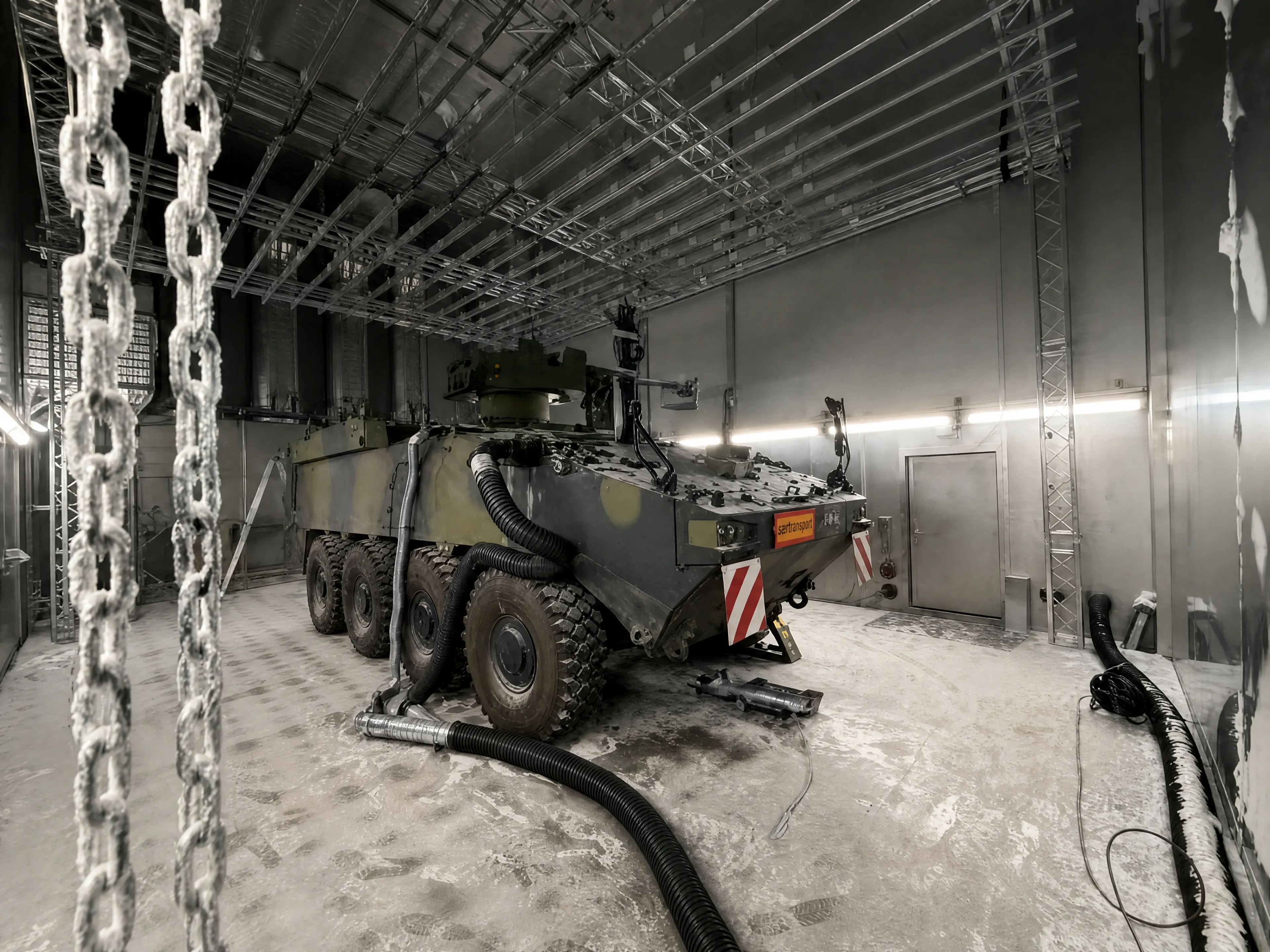
Executed comprehensive cold testing at -46 °C inside Force Technology’s largescale climate chamber in line with military specifications such as STANAG 4370, AECTP-230 and the relevant MIL-STDs.
Result
Confirmed performance and resilience of both platforms in extreme cold, enabling successful delivery to the Danish MoD.
Climate chamber testing at -46°C demonstrated that GDELS-Mowag's military vehicles met demanding defence standards before delivery to the Danish Armed Forces.
To demonstrate their performance under the extreme conditions of arctic environments, General Dynamics European Land Systems-Mowag GmbH (GDELS-Mowag) commissioned rigorous climate chamber testing of its Eagle and Piranha vehicles in use with the Danish Armed Forces.
GDELS is a European defence company headquartered in Madrid, Spain. GDELS operates across multiple European sites with more than 3,000 employees supporting customers worldwide, including NATO and EU member states.
The company specialises in military mobility solutions, producing wheeled and tracked armoured vehicles, highly mobile bridge systems, and artillery systems for defence forces. GDELS delivers its products and integrated services to over 50 countries worldwide.
GDELS–Mowag is the group’s subsidiary in Switzerland, manufacturing both the Eagle and the Piranha.
Climatic testing ensures military readiness
"GDELS needed to prove their armoured vehicles could handle the harshest cold conditions. Testing at -46 °C was a requirement from their end user DALO," says Rasmus Gehrt Cardél, test engineer at Force Technology.
The vehicles were subjected to a comprehensive series of climate chamber tests at Force Technology's 900 m³ facility in Lindø. The objective was to demonstrate compliance with military standards under arctic-like temperatures as low as -46 °C.
Compliance with STANAG 4370 standard is required
The test was designed to evaluate the armoured vehicles' ability to cold-start and perform under a range of temperatures. The vehicles were cooled stepwise from -32 °C to -46 °C, in accordance with standardised test protocols (C1 and C2).
The test not only assessed the vehicles themselves, but also the performance of integrated subsystems required and delivered by DALO.
"These tests serve a critical purpose: Not only to validate the vehicle’s performance, but to confirm, beyond doubt, that every integrated system continues to operate flawlessly under the most extreme conditions," says Mehdi Banisi, Senior Business Development Manager, Defence & Space at Force Technology.
A dual climate chamber setup cut costs and supported dynamic planning
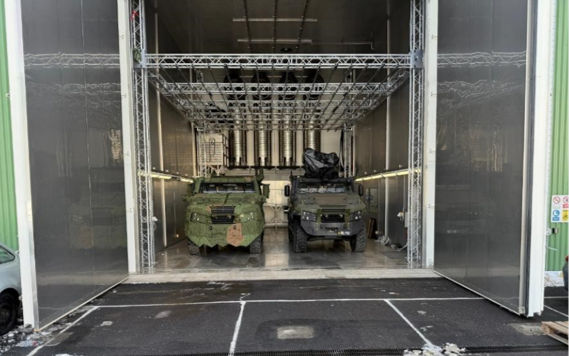
A key benefit was the size and flexibility of the climate chamber, which enabled simultaneous testing of two vehicles. This allowed for either parallel testing of different configurations or benchmarking performance between systems.
"During the negotiations, GDELS asked if a second vehicle could be included. Because of the chamber size of 900 m3 and setup, we were able to accommodate this without issue," explains Rasmus Gehrt Cardél.
This flexibility not only reduced time and cost but also aligned with the customer's dynamic testing schedule, which had already shifted several times due to changes in the overall delivery plan.
Proximity to the end user ensured smoother validation and faster decisions
GDELS-Mowag chose to conduct the tests in Denmark rather than at facilities closer to their location in Switzerland. One reason was the geographical proximity to the end user, the Danish Armed Forces.
"It was important for us to conduct testing close to DALO. That made it easier for their representatives to participate in the test sessions together with us, and by using a Danish company we demonstrated a maximum level of transparency and trust," a representative from GDELS–Mowag said.
The possibility of involving both the customer and their end user directly in the test process was a decisive factor. Force Technology's experience with military standards and previous collaboration with GDELS on the Piranha platform further supported the decision.
An agile partner for complex defence testing
Throughout the preparation phase, Force Technology demonstrated its ability to handle complexity, meet short deadlines, and manage uncertain inputs, including ongoing changes to test configurations.
"Throughout the project, Force Technology showed strong technical understanding and agility, helping us manage evolving timelines and coordinate effectively with DALO," the GDELS representative explained.
Strong expectations for the climatic test result
"We have a good track record with these armoured vehicles, and we expected full compliance with the applicable standards. Our goal was to prove functionality and robustness under real operational conditions, and we are happy to demonstrate the performance and full compliance of our vehicles under such cold conditions," he concluded.
The tests will provide documented evidence of operational readiness, a critical requirement for delivery to the Danish Armed Forces and subsequent deployment in international missions.