
Insights
Emissions from pyrolysis plants – overview of environmental impact and legal requirements
What are the legal requirements for emissions from pyrolysis plants – and which substances require particular attention when the flue gas reaches the surrounding environment?
Pyrolysis plants and emissions
Denmark aims to become climate neutral by 2045 and to reduce greenhouse gas emissions by 110 percent by 2050 compared with 1990 levels. This means that Denmark must not only be neutral and eliminate all its emissions, but also remove more from the atmosphere than it emits, for example CO₂.
Pyrolysis has significant potential for CO₂ storage and for the recycling or utilisation of organic waste streams [2], [6], and the Danish government has identified pyrolysis as a possible pathway to achieving the climate targets [1]. The government has therefore allocated financial resources and initiated projects to promote the deployment and technological development of pyrolysis, and to investigate the environmental impact, regulatory needs and climate effects of the process [1].
Interest in pyrolysis is increasing, both in Denmark and abroad [2], [3], [4], but the method is far from new. For example, pyrolysis oils were used throughout history in Egypt for embalming the dead [3], and in the Amazon, pre-Columbian societies used pyrolysis to produce charcoal for soil improvement several thousand years ago [5].
This article provides an overview of emissions from pyrolysis plants and the applicable legislation that regulates the environmental impact of emissions to the surrounding environment.
The pyrolysis process explained briefly
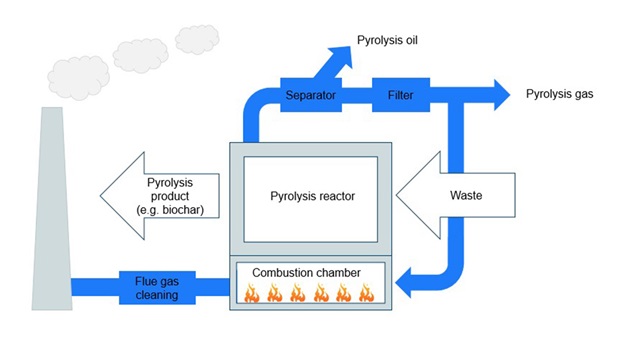
Pyrolysis is a thermal treatment process that takes place at high temperatures, typically above 300-400 °C, under oxygen-free conditions. The absence of oxygen allows the formation of synthesis gas/pyrolysis gas, pyrolysis oils and solid carbon (biochar). In addition, the heat generated in the process can potentially be utilised.
Figure 1 below shows a simplified example of a pyrolysis plant.
The material used in the pyrolysis process typically consists of different types of waste and residual products. What these materials have in common is that after pyrolysis they can be used in a more appropriate way – for example as a raw material, a complex material with specific chemical properties or an energy resource. In the following, these materials are collectively referred to as “waste”, regardless of their original nature.
Waste type, temperature profile and residence time play a decisive role in which pyrolysis products are formed – and in what quantities. By controlling the heating rate, final temperature and gas residence time, and possibly the addition of air or steam, it is possible to optimise the production of biochar, pyrolysis oil and gas [3], [6]. Slow heating, low final temperature and long gas residence time maximise the production of biochar. Rapid heating, moderate final temperature and short gas residence time instead maximise oil production, while slow heating, high final temperature and long gas residence time maximise gas production.
The pyrolysis process can take place either endothermically or exothermically, depending on the material and the process conditions. An endothermic reaction requires external heat input to maintain the pyrolysis process, whereas an exothermic reaction can contribute to energy production, as certain materials release heat during decomposition. For endothermic pyrolysis processes, the pyrolysis gas produced is often used to generate heat for the process itself. This combustion leads to emissions to the ambient air. The national legislation that applies to these emissions is addressed in this article.
Waste types used for pyrolysis in Denmark
In Denmark, commercial pyrolysis production takes place at plants of varying size, from 0.2-20 MW [1]. In 2024, around 6 commercial plants were in operation nationwide, with several more planned [1]. A common feature of the existing pyrolysis plants is that the heat is not utilised in the energy supply.
Emissions from the combustion of pyrolysis gas are highly dependent on the chemical composition of the feedstock and thus on which materials are subjected to pyrolysis [3], [6].
The waste and residual products that are particularly suitable for use in Denmark include: sewage sludge, plastic waste, end-of-life tyres, residual biomass from biogas plants, agriculture and the food industry, garden and park waste, seaweed and sediments [2], [6]. Certain waste types require size reduction and pelletising before pyrolysis, and some types contain so much water that pre-drying is necessary [6].
Examples of emissions from different waste types
Table 1 shows examples of emissions that may be released during combustion of pyrolysis gas, based on selected waste types. The overview includes both theoretically expected emissions [6] and measured components that have been reported in the scientific literature [3]. The overview is not exhaustive. The measured emissions vary in quantity and may occur at concentrations both below and above the applicable emission limit values, depending on process conditions and waste composition [3].