
Fast Ultrasonic Weld Inspection – automated inspection of welds in wind structures
Get automated weld inspection that supports continuous production and decision-making for wind energy manufacturing teams.
The Fast Ultrasonic Weld Inspection (FUWI) unit is an automated inspection solution used by production, quality and inspection teams in wind energy manufacturing where towers, monopiles and transition pieces are produced at scale. The need typically arises when weld inspection must keep pace with continuous production without slowing the flow of large structures through the line. When inspection depends on manual or semi-automatic approaches, limited capacity and delayed feedback can increase roller time, create bottlenecks and postpone corrective actions. By allowing weld inspection to be carried out as components move through production, the product replaces uncertainty with consistent insight into weld condition and geometry. This helps teams maintain throughput, reduce delays and document weld quality throughout fabrication.
When weld inspection becomes a bottleneck in production, uncertainty disrupts flow and delays corrective actions for wind energy manufacturing teams.
- Manual inspection slows production flow
Manual or semi-automatic weld inspection is time-consuming and often cannot keep pace with continuous production, increasing roller time and creating bottlenecks as large structures move through the line. - Limited inspection capacity delays feedback
Dependence on qualified NDT operators that are difficult to recruit can delay inspection results, leaving production and quality teams without timely input to address weld issues. - Inconsistent inspection data increases uncertainty
Variation in manual inspection approaches can lead to inconsistent information on weld condition, making it harder to assess quality and decide when corrective actions are needed. - Delayed corrective actions increase risk and rework
When weld quality issues are identified late, corrective actions are postponed, increasing the risk of rework, production delays and disrupted fabrication schedules.
Benefits
Cut ultrasonic testing costs by up to 95 %
Inspection keeps pace with welding, reducing roller time and preventing delays on towers, monopiles and transition pieces.
Halve operator time
One operator manages scanning and evaluation using FUWI hence reducing dependence on scarce NDT personnel and lower annual labour costs.
Achieve payback in less than 12 months
Lower staffing demand, faster inspection and less need of roller time supports payback in less than 12 months.
Ultrasonic inspection platform
The system operates on a 64/128-channel phased array ultrasonic testing platform supporting multi-probe operation. Time of Flight Diffraction channels run alongside phased array inspection for weld-root and through-wall defect characterisation together with pulse-Echo for transverse cracks . Phased array, ToFD, Pulse-Echo and high-resolution 3D surface data are acquired in a single workflow. Material thicknesses up to 150 mm can be inspected on typical monopile, tower and transition-piece sections.
Scanning mechanics and motion control
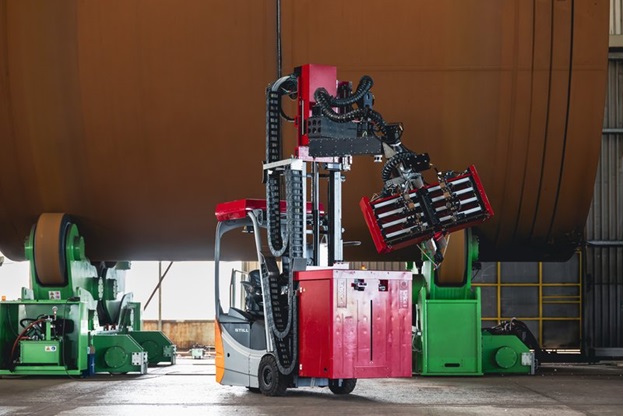
A multi-jointed arm with six degrees of freedom ensures controlled probe positioning along large curved structures. Laser-based seam tracking maintains alignment with the weld centreline during movement. Circumferential welds are inspected in a single rotation, with direct transition to longitudinal welds without reconfiguration. The scanner is mounted on an industrial forklift for stable positioning along large wind-component sections.
Integrated utilities and mobility
The inspection system is fully self-contained with its own onboard water tank, pump system and power supply. This allows scanning to take place without reliance on fixed facility infrastructure. Mobility enables repositioning along the fabrication line to follow sequential welds on towers, monopiles and transition pieces.
Data capture, processing and storage
Phased array, ToFD, Pulse-Echo and 3D geometrical data are acquired simultaneously with continuous positional referencing. Real-time analysis identifies weld geometry, signal responses and indication locations during scanning. All data is recorded, evaluated and reported within a single workflow, with automatic export to local servers or cloud storage. Output supports quality assurance and Advanced APQP systems.
Performance characteristics
Inspection speeds reach up to 30 mm per second, matching welding speed for typical wind-component fabrication. Circumferential welds are evaluated in one complete revolution. The system maintains stability on rotating sections and tracks long seam welds across large diameters without interrupting production. High-resolution 3D scans provide additional context for weld geometry and structural deformation when required.
Inspection aligned with recognised quality frameworks
• ISO 16810: general principles for ultrasonic testing
• ISO 17640: ultrasonic testing of welds
• EN ISO 10863: Time of Flight Diffraction (ToFD) for weld inspection
• EN ISO 13588: phased array ultrasonic testing of welds
• Procedures documented to support QA and APQP in wind-component fabrication.