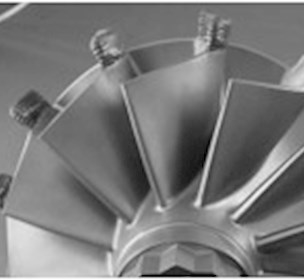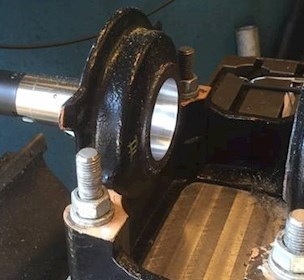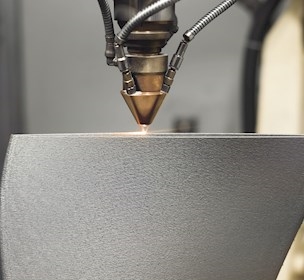
Laser cladding with powder ensures a higher quality of process equipment
SPX FLOW has observed improved surface finish and reduced post-processing by shifting from wire to powder in the laser cladding process.
Challenge
SPX FLOW examined whether a new alloy and a powder-based laser surface treatment could improve the internal surfaces of process equipment.
Solution
FORCE Technology developed a method for applying wear-resistant surfaces to the inside of process equipment using powder-based laser cladding.
Result
Initial evaluations indicate that powder-based laser cladding can reduce variation in coating quality and the need for post-processing.
Wear caused by food products can significantly affect service life
SPX FLOW develops and manufactures, among other things, process equipment for the food industry, where high requirements are placed on materials that come into contact with food. Certain liquid food products contain fine particles that can cause abrasion and wear on internal surfaces over time.
To protect equipment and support long service life, SPX FLOW applies a highly wear-resistant coating to relevant internal surfaces. Without surface treatment, the lifespan can be significantly shorter, depending on the application and product environment.
Evaluating powder-based laser cladding
Historically, SPX FLOW applied wear-resistant metal alloys using a wire-fed lasercladding process. While effective, this method could result in variations that require extensive manual grinding.
When FORCE Technology introduced a powder-based alternative, SPX FLOW evaluated the method to determine its potential benefits for select equipment.
"I was contacted by FORCE Technology regarding a potential novel approach for applying the alloy. We are always open to exploring technologies that may support product quality or manufacturing efficiency," says Knud Thorsen, mechanical and welding engineer (IWE) at SPX FLOW.
From wire to powder: More uniform surfaces and fewer corrections
Compared to the wire-based method, powder-based laser cladding provided a smoother, more consistent surface in SPX FLOW's internal tests, reduced the need for manual grinding, and resulted in fewer cases requiring corrections.
"When corrections are necessary, it affects both our own and our customers' planning, so reduced variation in the process is valuable," says Knud Thorsen.
The coating was also assessed for adhesion and stability, including wear simulation. "It's crucial that the coating remains stable and does not chip or flake. Our testing showed that the powder coating integrated well with the surface," Thorsen explains.
Full-scale trials aligned with expectations. "The surface achieved with powder-based cladding is more uniform, and we identified very few deviations during inspection," he says. "This contributes to more predictable production planning."
Powder-based laser cladding: An investment that can support manufacturing efficiency
While the service life of the coating depends on the application environment, SPX FLOW's evaluations show that powder-based laser cladding can streamline several steps in the production chain. Reduced rework, more consistent surface quality, and decreased grinding time all contribute to higher manufacturing efficiency.
"We can significantly reduce grinding requirements, and the resulting surface appearance is more uniform," says Thorsen. "It also helps minimise discussions about visual variations, as the finish is more consistent. Based on our testing, this method offers clear advantages compared to our previous approach," Kurt Thorsen from SPX Flow concludes.